How to play darts: the rules, the throw, and a full 501 leg
How to play darts, in one paragraph: hang the board with the center of the bull 5 ft 8 in off the floor, stand 7 ft 9¼ in back, and throw three darts per turn. Subtract what you hit from 501. First to exactly zero, finishing on a double, wins the leg.
What you need to start
A board, three darts each, and a line on the floor. That's the kit.
The board. A standard bristle "clock" board is 17¾ in (451 mm) across overall, of which the scoring area — out to the outer edge of the double ring — is 13⅜ in (340 mm). Sisal, not cork; cork chews up after a few hundred throws.
The darts. Steel-tip darts are capped at 50 g and 300 mm overall length under WDF and PDC rules, and nobody throws near either limit. Most players sit between 21 g and 26 g. House darts off the pub wall are fine for your first year.
The oche. Pronounced "ockey," it's the throw line. Hang the board with the center of the bull 5 ft 8 in (1.73 m) from the floor, then measure 7 ft 9¼ in (2.37 m) horizontally from the face of the board to the front edge of the line. If the diagonal from bull to oche reads 9 ft 7⅜ in (2.93 m), both numbers are right. Soft-tip and electronic boards keep the same height but move the line back to 8 ft (2.44 m).
Leave a few feet of clear floor behind the oche and light the board from the front, or your own shadow sits on the 20.
How the dartboard scores
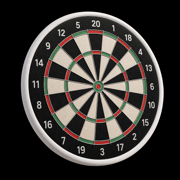
Twenty numbered wedges run clockwise from the top: 20, 1, 18, 4, 13, 6, 10, 15, 2, 17, 3, 19, 7, 16, 8, 11, 14, 9, 12, 5. Big numbers sit beside small ones on purpose — a sloppy dart at the 20 lands in the 1 or the 5.
- Thin outer ring — double the wedge number. Double 20 is 40.
- Thin inner ring — treble (triple, in the US). Treble 20 is 60, the most a single dart can score.
- Green outer bull — 25.
- Red inner bull — 50, and it counts as a double.
- Outside the double ring — nothing.
Three treble 20s make 180, the maximum for one turn.
How a turn works
You throw three darts, one at a time, both feet behind the oche. Leave them in the board. Wait for the score to be called and written down, then pull all three at once and hand over the throw.
The point decides the score, not the flight. A dart leaning across the treble wire scores whatever bed the tip is buried in.
One turn is a "visit." A "leg" is one full game from 501 to zero. Matches are commonly best of five or seven legs; longer formats stack legs into sets.
Who goes first in darts
Both players throw one dart at the bull, and the closest to the middle throws first. Inner bull beats outer bull, outer bull beats anything outside the bull, and if you both land in the same ring you throw again — with whoever went second now going first.
This is the bull-up, or diddle for the middle. Under WDF rules, a first dart that lands in the bull or the 25 is pulled before the opponent throws, so nobody gets blocked out. The winner gets the choice of throwing first and always takes it, because the thrower gets first crack at the finish. After that, the throw alternates leg by leg.
How to play darts: one full 501 leg
Both players start on 501. Here's a leg at a realistic beginner's pace.
Scoring visits. Aim at the treble 20 and accept singles. Plenty of newer players score better on the 19s — treble 19 is 57 against 60, and the 19 bed is flanked by 3 and 7 instead of 20's brutal 1 and 5.
- 20, 5, 20 = 45 → 456
- 1, 20, 20 = 41 → 415
- T20, 20, 5 = 85 → 330
- 20, 20, 20 = 60 → 270
- 20, 1, 20 = 41 → 229
- T20, 20, 20 = 100 → 129
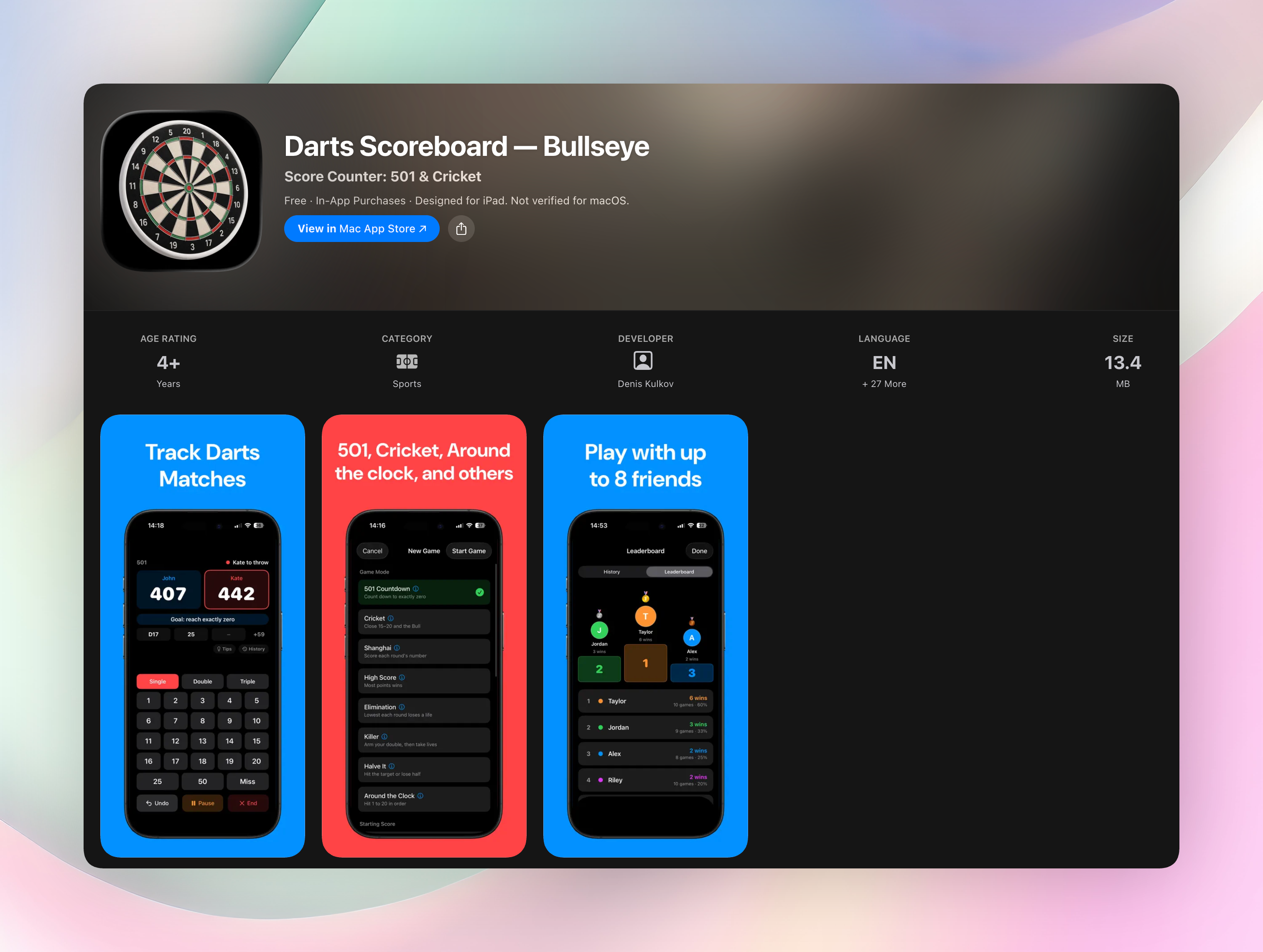
Keeping score. The marker writes the turn total, then the new remainder underneath it. Subtracting three darts from a four-hundred-something number, in your head, standing up, while somebody waits — that's where beginners stall. Darts Scoreboard is a darts scoreboard app for iPhone that tracks your games, and it does the subtraction the moment you tap in what you hit.
Setting up the finish. On 129 you're not going out, so play for a double. Two single 20s put you on 89, and a treble 19 with the last dart leaves 32. That's the number to aim for, because 32 halves cleanly: miss double 16 into the single and you're on 16, then 8, then 4. Every miss still leaves a double.
The checkout. From 32 you throw at double 16. The first dart clips the single 16, leaving 16. The second catches single 8, leaving 8. The third misses the double ring. Turn over, still on 8. Next visit, first dart, double 4 — zero, leg won.
The last dart has to land in a double or the inner bull. Every score from 170 down has a three-dart route out except 169, 168, 166, 165, 163, 162 and 159. The biggest possible finish is 170: treble 20, treble 20, bull.
Some pubs and leagues play "straight out," where any segment finishes, and a few play "double in," where nothing counts until you open with a double. Agree which before the first dart.
The darts rules beginners get wrong
Most arguments at the board come from four rules of darts, not from the scoring.
Bust
Your score can't go below zero, can't land on exactly 1, and can't reach zero on anything but a double. Any of those is a bust: the visit is wiped, your score reverts to what it was when you stepped up, and you don't throw the darts still in your hand. Sitting on 32 and hitting a treble 20 puts you back on 32 with two darts and nothing to do with them.
Bounce-outs and droppers
A dart that bounces off a wire, or drops out of the board before the score is marked, scores nothing and can't be re-thrown. You're simply down a dart. Electronic soft-tip machines usually allow a re-throw, since the board never registered it. This is also why you never pull a dart before the score has been called.
A dart in a dart
Land a dart in the barrel of one already in the board — a Robin Hood — and it scores nothing. It never touched the board.
Feet over the line
No part of either foot may cross the front edge of the oche, though you can lean over it as far as your balance allows. Penalties vary: casual play gives you a warning, while under tournament rules the darts count as thrown and score nothing.
Which game to play, by how many people are standing there
| Players | Game | Object | Why it fits |
|---|---|---|---|
| 1 | Round the Clock | Hit 1 through 20 in order, then the bull | Forces you onto every bed, not just the 20 |
| 2 | 501, best of 5 legs | Zero out on a double | The format the pros play |
| 3 | Cricket | Close 20 down to 15 plus the bull, then score on them | Blocking matters more than raw power, so mismatched players stay in it |
| 4 | 501 doubles | Two per team, throwing in strict rotation | Nobody stands around; partners cover each other's bad visits |
| 5+ | Killer | Draw a number with your other hand, hit its double to become a killer, then hit rivals' numbers to take their lives | Everyone throws every rotation and eliminations keep it moving |
With a crowd of mixed ability, Killer beats 501, because a beginner who can reliably hit one specific number is dangerous.
FAQ
How far do you stand from a dartboard?
7 ft 9¼ in (2.37 m), measured horizontally from the face of the board to the front edge of the oche, with the center of the bull 5 ft 8 in (1.73 m) off the floor. Soft-tip boards move the line to 8 ft (2.44 m). The diagonal check is 9 ft 7⅜ in (2.93 m).
What happens if you score more than you need?
You bust. The visit doesn't count and your score goes back to where it was at the start of the turn. The same applies if you land on exactly 1, or hit zero without a double.
Do you have to finish on a double?
In standard 501, yes — the last dart has to be in a double or the inner bull. Traditional 301 often adds a double to start as well. Some pub and league formats play straight out instead, where any segment that brings you to zero wins. Settle it before you throw.
Who goes first in darts?
Each player throws one dart at the bull and the closest to the center chooses the throw. Inner bull beats outer bull beats a miss, and ties are re-thrown with the order swapped. After the first leg, the throw alternates.
Does a dart count if it bounces out?
No. On a steel-tip board, a bounce-out or a dart that drops before the score is marked counts for nothing, and you don't get to throw it again. Electronic boards are the exception — most let you re-throw, because nothing registered.
Free Darts tools
- Darts Checkout CalculatorUse this darts checkout calculator to find the best route from your score, see alternative finishes and choose a preferred double.
- Darts Cricket ScorerTrack every player's marks and points in a live darts cricket scoreboard, with open or closed numbers and the winner shown as the game develops.
- Darts Double Out ChartGenerate a complete darts double out chart from 2 to 170. Choose a preferred finishing double and print a route for every finishable score.
- Darts Match CounterA one-handed darts counter for live 301 and 501 matches. Enter each visit to see remaining scores, averages, checkout routes and leg or set state.
- Darts Score Chart CalculatorUse this darts score chart calculator to turn a selected board number and multiplier into the points scored, including valid outer and inner bull options.