Darts scoring explained: how points are counted, dart by dart
Darts scoring is subtraction. Each dart scores the value of the segment it lands in — doubled in the thin outer ring, trebled in the thin inner ring — and your three darts are added up and taken off your remaining score. You start at 501 and race to exactly zero, finishing on a double.
What each part of the board is worth
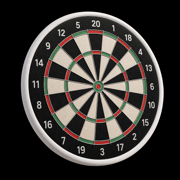
The board is 20 numbered wedges, arranged so the big numbers sit between small ones. The 20 has the 1 and the 5 either side of it. The 19 has the 3 and the 7. Miss the fat part of the 20 by half an inch and you've scored 5.
Two thin rings cross every wedge. The outer one, at the edge of the playing area, doubles the number. The inner one, set between the bull and the outer ring, trebles it — that's where 60, the highest score available from a single dart, comes from. The two large areas left over, inside and outside the treble ring, are singles and score face value.
The middle has two rings of its own: the green outer bull at 25, and the red bull in the center at 50. Under standard rules the 50 counts as a double 25. The 25 is just 25.
| Where the dart lands | Value | Example on the 20 |
|---|---|---|
| Single (the two large areas of a wedge) | Face value | 20 |
| Double (thin outer ring) | ×2 | 40 |
| Treble (thin inner ring) | ×3 | 60 |
| Outer bull (green ring) | 25 | — |
| Bull (red center) | 50, counts as double 25 | — |
| Outside the double ring | 0 | — |
That table is the entire darts scoring chart. Everything after it is arithmetic.
One detail decides most close calls: a dart's value comes from which side of the wire the point entered, not from where the flight ends up sitting.
How does darts scoring work over a three-dart turn
You throw three darts, add them into one turn total, and subtract that total from what's left.
Work a turn from 501. First dart, treble 20: 60. Second dart, single 20: 20. Third dart, double 20: 40. Turn total 120, so 501 − 120 = 381.
Notice what the double did there — nothing special. Mid-leg, a double 20 is 40 points and no more. Doubles only carry extra meaning on the dart that takes you to zero.
The ceiling for one turn is 180, three treble 20s. Under that, the totals you'll hear called are 140 (two trebles and a single 20), 100, 85, 60. You'll hear 26 a lot too: single 20, single 5, single 1, the signature of three darts drifting across the top of the board.
How to keep score in darts on a chalkboard
Split the board down the middle, a player each side. Under each name, two columns: what the turn scored, and what's left after it.
        ME                 |          YOU
   scored    left          |     scored    left
              501          |                501
     120      381          |        45      456
      26      355          |       100      356
     140      215          |        60      296
The caller announces the turn total, writes it in the left column, and writes the new remainder beside it. The remainder is the number that matters — it's what the next player is throwing at, and it's the number to say out loud when they ask.
Two habits make the arithmetic quick. Subtract to a round number first: 381 − 26 becomes 381 − 30 + 4. And learn the common totals cold, because 60, 100, 140 and 180 are what you'll be taking off for the rest of your playing life. That's the whole of how to score darts by hand.
The darts scoring rules that settle arguments
Three rules cause almost every disagreement at the oche.
Bust wipes the whole turn
You bust if a dart would take your score below zero, leave you on exactly 1, or bring you to zero without a double. When it happens the turn doesn't count at all. Your score reverts to what it was before you threw, and under WDF and PDC rules the throw ends there — any darts still in your hand aren't thrown. Casual games sometimes let you throw them out of habit; the score still reverts either way.
Say you're sitting on 40. First dart lands in the single 20, leaving 20. Second dart finds the treble 20 — 60 points against 20 remaining. Bust. You don't keep the 20 from the first dart, and the chalk still reads 40 when the darts pass to your opponent.
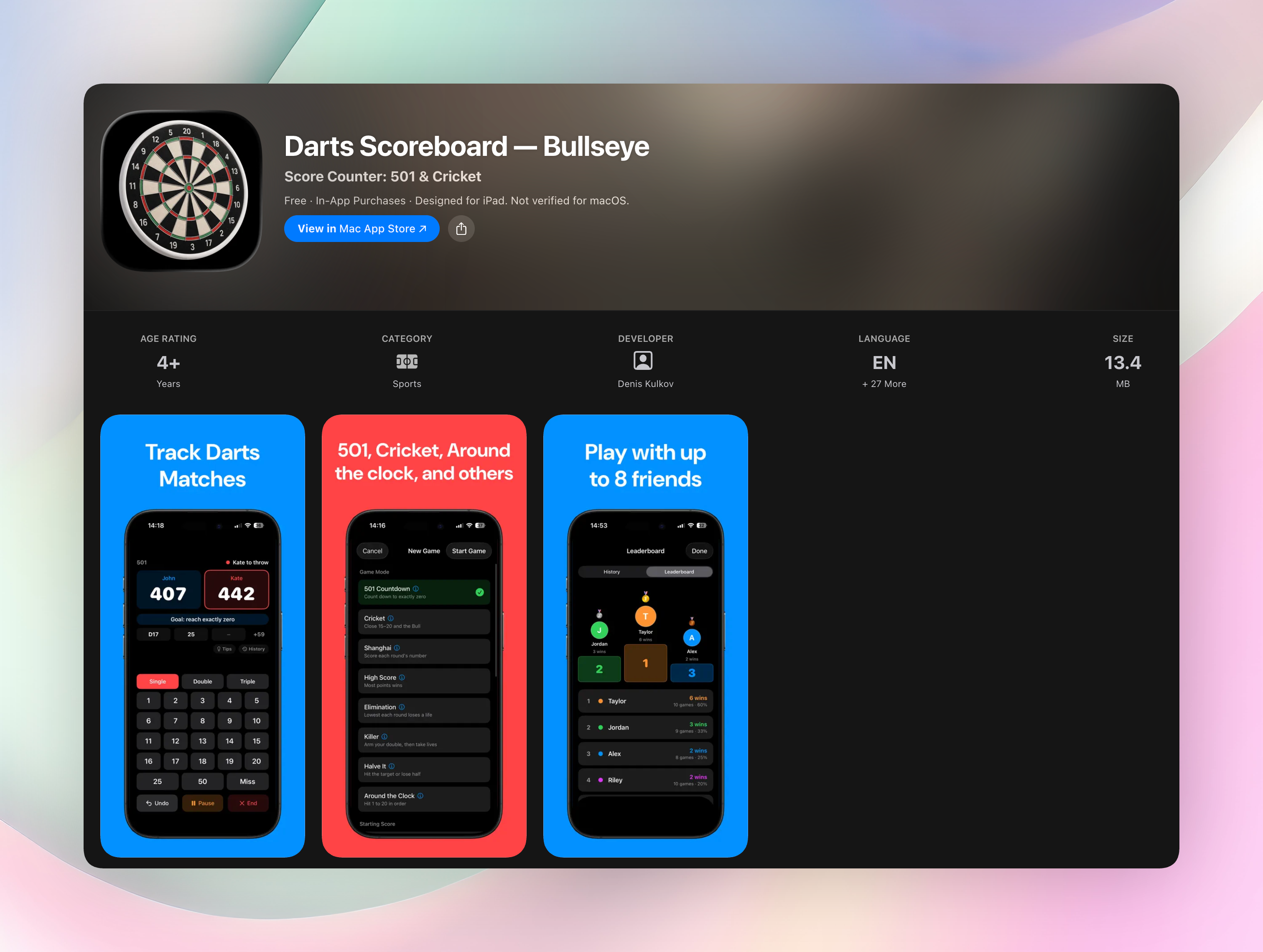
This is where scoring goes wrong most often: a bust gets subtracted instead of reverted, or a checkout gets written down that never actually landed in a double. Letting something else hold the numbers takes the argument off the table — Darts Scoreboard is a darts scoreboard app for iPhone that tracks your games, so the running total isn't a matter of anyone's memory.
The finishing dart has to be a double
The last dart of a leg has to land in the double ring, or in the bull, which counts as double 25. Reaching zero any other way is a bust.
That turns the back end of a leg into a route-planning problem. From 40 you throw double 20. From 32, double 16. From 50 you can take the bull. From 2 it's double 1, the leave nobody wants, because a miss into the single 1 puts you on 1 and busts you. Every double is even and so is the bull, so an odd total needs a setup dart first — on 37, hit the single 5 and you're on 32.
The biggest three-dart checkout is 170: treble 20, treble 20, bull. Nothing above 170 can be finished in three darts, and seven scores below it can't either — 169, 168, 166, 165, 163, 162 and 159. Land on one of those and the job for the turn is to score down to a number that works.
A dart that doesn't stay in the board scores nothing
Bounce-outs are the harsh one. A dart that hits the board and drops to the floor counts as thrown, scores zero, and isn't re-thrown. The same goes for a dart that catches a wire and falls, and for one that sticks in the flight of a dart already in the board without reaching the surface.
Darts also stay in the board until the score has been called and written down. Pull them out early and you've handed the decision to whoever's holding the chalk. Once the winning double lands, the leg is over — anything thrown after it counts for nothing.
501, 301 and the double-in variant
The scoring system in darts is identical across the whole X01 family. Only the starting number and the entry rule change.
501, straight-in, double-out. The standard for professional singles and most league play. You score from your first dart and must finish on a double.
301, often double-in. Shorter, common in doubles and pub leagues. Double-in means nothing counts until one of your darts lands in a double, so a 60 thrown before that is worth zero.
701 and 1001. Pairs and team formats. Same rules, longer legs.
A leg is one race from the starting number to zero; a set is a group of legs. Neither changes how a dart is counted. Electronic soft-tip machines score for you, and plenty of their default games are open-out, where any segment can finish a leg — check the setting before the first leg counts. If you're still working out the throwing side of it, how to play darts covers stance, order of play and the etiquette around the oche.
FAQ
What is the highest score with three darts?
180, from three treble 20s. The highest single dart is 60, also the treble 20. The highest possible checkout is lower — 170, treble 20, treble 20, bull — because the last dart has to be a double and the bull is the biggest one on the board.
Does the bullseye count as a double?
The red inner bull, worth 50, counts as double 25, so you can check out on it from 50. The green outer bull is a flat 25 and can't finish a leg. During normal scoring both are just points.
What happens if you score more than you need?
You bust. The turn is void and your score goes back to what it was before you threw. Being left on exactly 1 is a bust too, since 1 can't be finished on a double.
Do you have to start on a double in 501?
Not in standard 501, which is straight-in — you score from the first dart. Some 301 and league formats play double-in, where nothing registers until you hit a double. Agree which one you're playing before the first leg.
How do you keep score in darts without a chalkboard?
Pen and paper works the same way: turn total in one column, the remainder next to it. Plenty of players use a scoring app on a phone instead, which does the subtraction for you and keeps a record of the leg.
Free Darts tools
- Darts Checkout CalculatorUse this darts checkout calculator to find the best route from your score, see alternative finishes and choose a preferred double.
- Darts Cricket ScorerTrack every player's marks and points in a live darts cricket scoreboard, with open or closed numbers and the winner shown as the game develops.
- Darts Double Out ChartGenerate a complete darts double out chart from 2 to 170. Choose a preferred finishing double and print a route for every finishable score.
- Darts Match CounterA one-handed darts counter for live 301 and 501 matches. Enter each visit to see remaining scores, averages, checkout routes and leg or set state.
- Darts Score Chart CalculatorUse this darts score chart calculator to turn a selected board number and multiplier into the points scored, including valid outer and inner bull options.