Dart board scoring: every ring, number and bull explained
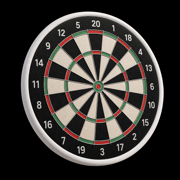
Dart board scoring runs on five zones. Every numbered segment is worth its face value; the thin outer ring doubles it and the thin inner ring trebles it. The outer bull is 25, the bullseye is 50, and anything outside the double ring scores nothing.
How dart board scoring works, zone by zone
A standard board is split into 20 wedges, and two narrow wire rings cut each wedge into four beds. Add the two circles in the middle and the board has 82 scoring areas.
| Zone | Where it sits | What it scores | On the 20 wedge |
|---|---|---|---|
| Inner single | Between the bull and the treble ring | Face value | 20 |
| Treble (triple) ring | Narrow ring about two-thirds of the way out | 3x face value | 60 |
| Outer single | Between the treble and double rings | Face value | 20 |
| Double ring | Narrow ring at the outer edge | 2x face value | 40 |
| Outer bull, the "25" | Green ring around the center | 25 | — |
| Bullseye, the "bull" | Red circle at the center | 50 | — |
| Outside the double wire | Anywhere past the outer ring | 0 | 0 |
Both scoring rings are the same width — 8 mm measured inside the wires under World Darts Federation specs — but the treble sits far closer to the center, so its arc is shorter. A treble bed is a physically smaller target than the double bed of the same number. For scale, the scoring surface runs 170 mm from the center to the outside of the double wire, and the treble band sits between 99 and 107 mm. The bullseye is 12.7 mm across, the green ring around it 31.8 mm.
A treble is worth three times the segment, not three darts. Treble 20 is one dart worth 60. That is the piece of dart board scoring beginners get wrong most often, and it bites the moment you start subtracting from 501. If you'd rather not run the arithmetic between visits, Darts Scoreboard is a darts scoreboard app for iPhone that tracks your games, and its segment keypad marks singles, doubles and trebles as separate buttons so the multiplier gets recorded rather than guessed.
If the format itself is still new to you, the beginner's guide to playing darts covers throwing order and the double-out rule.
Dart board numbers in order, clockwise from 20
Starting at the top and working clockwise:
20 – 1 – 18 – 4 – 13 – 6 – 10 – 15 – 2 – 17 – 3 – 19 – 7 – 16 – 8 – 11 – 14 – 9 – 12 – 5
That order is identical on every regulation board, so learn the neighbors of the beds you actually aim at:
- 20 sits between 5 and 1
- 19 sits between 3 and 7
- 18 sits between 1 and 4
- 17 sits between 2 and 3
- 16 sits between 7 and 8
- 14 sits between 11 and 9
How to read a dart board at a glance
Four numbers anchor the clock face: 20 at twelve, 6 at three, 3 at six, 11 at nine. Each wedge covers 18 degrees, so once those four are fixed you can count round to anything else in a second.
Color does the rest. The wedges alternate black and cream, and each wedge's double and treble beds are red or green. The bullseye is red, the 25-ring around it green. In a badly lit pub that pairing reads faster than the numbers on the outer band, which is why callers score by bed color as much as by digit.
Why 1 and 5 sit either side of 20
The layout exists to punish a miss, not to forgive one. High numbers are ringed by low ones, so a dart that drifts a few millimeters off the 20 lands in the 5 or the 1 and the visit collapses.
The arithmetic is tidy. All twenty numbers add up to 210, and every number borders two others, so the average adjacent pair sums to 21. High and low alternate around most of the ring, with two exceptions — 6 sits next to 10, and 11 sits next to 14.
Judging a target by its three-bed neighborhood, the number plus both of its neighbors, gives a rough price for a miss:
- 20 → 5 + 20 + 1 = 26
- 19 → 3 + 19 + 7 = 29
- 17 → 2 + 17 + 3 = 22, the harshest patch on the board
- 7 → 19 + 7 + 16 = 42, the most forgiving
Who designed it is murkier than the pub story allows. The sequence is usually credited to a Lancashire carpenter, Brian Gamlin, in 1896, but no record of the man has ever been found; the better-documented claim belongs to Thomas Buckle, a Yorkshireman said to have laid out the modern numbering in 1913. Either way the effect stands: in numerical order the 20 would border the 19, handing out a fortune for a bad dart.
The highest scores on a dart board
Treble 20 is the highest single-dart score at 60. Three of them make 180, the ceiling for a three-dart visit. American players say triple 20, British players say treble 20; same bed.
Bull matters at the finish more than during scoring. Under standard double-out 501 the bullseye counts as a double — double 25 — which makes 170 the highest possible checkout: treble 20, treble 20, bullseye. Nothing above 170 can be closed in three darts, and 169, 168, 166, 165, 163, 162 and 159 can't be closed either. Darts scoring covers how those finishes are built.
The outer bull does not count as a double. It's a single 25 and can't end a leg in a double-out game. Cricket and several soft-tip formats use a different convention — outer ring as a single bull, center as a double bull — so confirm the ruleset before a match.
Why treble 19 is the safer big score
Treble 19 pays 57 against treble 20's 60 — three points a dart, nine a visit. What you get back is a gentler miss. Slip off the 20 and you're in the 1 or the 5; slip off the 19 and you're in the 3 or the 7. The neighborhood totals above put that at 29 against 26.
Two other reasons players move down. The 19 bed sits lower on the board, closer to eye level in most stances, and when the first two darts crowd the treble 20 the third can deflect off their shafts. Moving across gives you a clean bed to throw at.
None of that makes the 19s better in the abstract. Professionals score on the 20s because three points a dart compounds across a match. Treat treble 19 as the fallback for a night when the 20 isn't landing, not an upgrade.
FAQ
How much is a bullseye in darts?
The bullseye, the red circle at the center, is worth 50 points. The green ring around it — the outer bull — is worth 25. They're the only two scoring areas on the board that don't belong to a numbered wedge.
What is a triple 20 worth in darts?
Sixty points from a single dart. The treble ring multiplies its wedge by three, so the treble bed on the 20 is 3 × 20. Three darts in it make 180, the maximum visit.
Does the bullseye count as a double?
In standard double-out games such as 501 and 301, yes — the bull is treated as double 25, so a leg can be closed on it. The outer 25 is a single and cannot finish. Cricket and some soft-tip formats use their own bull convention.
How many scoring areas are on a dart board?
Eighty-two. Twenty wedges with four beds each — inner single, treble, outer single, double — plus the outer bull and the bullseye. Everything past the double wire scores zero.
What number is opposite 20 on a dart board?
The 3, at the bottom of the board. The 19 sits opposite the 1, and the 17 sits opposite the 5. Opposite beds are always ten positions apart in the clockwise order.
Free Darts tools
- Darts Checkout CalculatorUse this darts checkout calculator to find the best route from your score, see alternative finishes and choose a preferred double.
- Darts Cricket ScorerTrack every player's marks and points in a live darts cricket scoreboard, with open or closed numbers and the winner shown as the game develops.
- Darts Double Out ChartGenerate a complete darts double out chart from 2 to 170. Choose a preferred finishing double and print a route for every finishable score.
- Darts Match CounterA one-handed darts counter for live 301 and 501 matches. Enter each visit to see remaining scores, averages, checkout routes and leg or set state.
- Darts Score Chart CalculatorUse this darts score chart calculator to turn a selected board number and multiplier into the points scored, including valid outer and inner bull options.