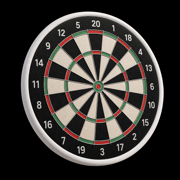
What is a dartboard made of, and why it heals itself
A tournament dartboard is made of tightly compressed sisal fiber — a plant fiber from the agave — packed end-on inside a steel ring and ground flat. A wire spider divides the scoring beds, and a removable number ring sits over it. Cheap boards swap the sisal for coiled paper or cork.
What is a dartboard made of, layer by layer
Sisal comes from Agave sisalana, grown mostly in East Africa, Brazil, and China. The leaves are crushed, the fiber washed and dried, and the strands graded by length and cleanliness.
A bristle dartboard is then built in four stages:
- Bundles. Fiber is cut to length and squeezed into small cylindrical bundles — biscuits, in factory shorthand — with every strand running the same direction.
- Compression. Those bundles are packed into a steel retaining band under heavy pressure, cut ends facing outward, and bonded to a backing board. The band never comes off; it keeps the face in tension.
- Facing. The fiber is ground and sanded dead flat, then the segment colors are printed onto it. A regulation playing surface measures 451 mm (17.75 in) across, and the board sits roughly an inch and a half deep.
- Hardware. The spider goes on, the number ring clips over it, and a bracket is fixed to the back.
"Bristle" describes the texture, not a discarded material — packed sisal fiber ends feel like the bristles of a stiff brush, which is where the name comes from. Nothing on a modern board comes from an animal.
Why a sisal fiber dartboard heals itself
The fibers stand end-on — perpendicular to the face, cut ends pointing at you. A dart arriving at that surface doesn't cut anything. It wedges between fiber ends and shoves them sideways, and compression from the steel band pushes them back when you withdraw the point. The hole closes because it was never really a hole.
That is the whole mechanism behind the phrase self healing dartboard, and it is why point condition matters. A smooth, moderately sharp tip parts fibers; a burred or hooked tip drags them out on the way back. Five minutes with a stone across your dart points does more for a board than any spray sold for the job.
What sisal will not survive is water. Soaking is inherited from elm boards, which were solid wood and sat in a bucket overnight so the grain swelled shut. Soak a sisal board and you get rot, rust under the wire, and a face that never comes back. Dartboard maintenance is the opposite: keep it dry, out of direct sun, away from radiators, and don't leave darts parked in it between sessions.
Bristle vs paper, cork, and electronic boards
| Board type | Made from | Closes its own holes | Darts | Realistic life |
|---|---|---|---|---|
| Bristle | Compressed sisal in a steel band | Yes, by compression | Steel tip | Years of regular play |
| Paper coil | Tightly wound paper or card | Briefly, then it pulps | Steel tip | Weeks to months |
| Cork | Pressed cork sheet | No — it crumbles out | Steel tip | Short |
| Electronic | Molded plastic segments full of holes | N/A — darts sit in the holes | Soft tip | Long, if you avoid steel tips |
Neither paper coil nor cork is under compression, so every dart removes material rather than displacing it: the bull goes first, then the face starts shedding. Electronic boards score themselves, but the surface is a plastic honeycomb of small holes with ribs between them, and a soft tip landing on a rib bounces straight out. Check steel tip vs soft tip before mixing the two — steel points wreck plastic segments, and soft tips won't hold in sisal.
The dartboard spider, and where bounce-outs come from
The spider is the wire framework separating the beds, including the double and treble rings and the bull. It is also the biggest single cause of bounce-outs, and boards differ enormously here.
Round wire is the old design: thick steel, circular in section, sitting proud of the sisal. A dart that lands on it meets a curved shoulder and gets kicked back. Triangular blade wire turns a knife edge toward the thrower, so a dart that would have rejected slides down one face into the bed. Blade wire is thinner too, which gives back a sliver of bed width.
Staples are the other culprit. Older boards pinned the wire at the segment junctions and around the bull, and those heads sit above the surface exactly where darts arrive. A staple-free bullseye anchors the bull wire below the face; better boards press the whole spider into the sisal so nothing stands proud anywhere.
Bounce-outs are where scoring arguments start, since a dart that rebounds onto the floor scores nothing and nobody remembers the total from before it fell. Darts Scoreboard is a darts scoreboard app for iPhone that tracks your games, so the running number isn't rebuilt from memory halfway through a leg.

How long do dartboards last
Longer than most boards actually last, because most die of neglect rather than throws. Wear is wildly uneven: on a 501 board the treble 20 absorbs the overwhelming majority of darts, so the 20 bed goes soft and cratered while 9, 12, and 14 look factory-fresh.
Rotating is the fix. Lift off the number ring, turn the board several segments on its bracket, then refit the ring with 20 back at the top — fresh sisal now does the heavy lifting. It only works on boards with a removable number ring; where numbers are printed on the face, wear stays where it fell. With the board down, check it's still level and at the right height, which how to hang a dartboard covers.
A board is finished when darts stop holding in the treble 20, the surface feels spongy under the point, tufts of fiber lift away from the face, or the wire has been shoved out of line so the double ring no longer runs true. None of it is repairable — sisal can't be topped up.
FAQ
Are dartboards made from pig bristle?
No. Modern boards are compressed sisal, a plant fiber from the agave — not animal bristle. The name refers to the texture: packed fiber ends feel like the bristles of a stiff brush, which is why sisal boards are called "bristle dartboards" to distinguish them from paper or cork ones.
Can you repair a hole in a dartboard?
Not lastingly. Sisal closes its own small holes through compression, but once fibers have been torn out there's nothing left to close. Fillers and glues harden the bed and make bounce-outs worse.
Should you soak a bristle dartboard in water?
Never. Soaking belongs to old elm boards, where water swelled the wood shut overnight. On sisal it rots the fiber, swells the backing, and rusts the wire.
How often should you rotate a dartboard?
Every week or two if you throw most days, monthly for casual play. Move it several segments at a time rather than one, so wear spreads around the face instead of piling into two or three beds.
Free Darts tools
- Darts Checkout CalculatorUse this darts checkout calculator to find the best route from your score, see alternative finishes and choose a preferred double.
- Darts Cricket ScorerTrack every player's marks and points in a live darts cricket scoreboard, with open or closed numbers and the winner shown as the game develops.
- Darts Double Out ChartGenerate a complete darts double out chart from 2 to 170. Choose a preferred finishing double and print a route for every finishable score.
- Darts Match CounterA one-handed darts counter for live 301 and 501 matches. Enter each visit to see remaining scores, averages, checkout routes and leg or set state.
- Darts Score Chart CalculatorUse this darts score chart calculator to turn a selected board number and multiplier into the points scored, including valid outer and inner bull options.