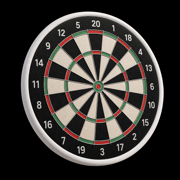
How to hang a dartboard the right way
How to hang a dartboard: center of the bull 5 ft 8 in (1.73 m) off the floor, front of the throw line 7 ft 9-1/4 in (2.37 m) from the face of the board — not from the wall. Check both with one diagonal pull, 9 ft 7-3/8 in (2.93 m).
Pick the wall and clear the throwing lane
Plan on about 11 ft of clear lane — the throwing distance plus standing room behind it. Leave 2 to 3 ft of bare wall either side of the board — that's where wide darts land, and where you don't want a window, TV, or light switch. Check the ceiling too — a basement ceiling under about 7 ft will clip a lofted throw.
What counts in the wall is what's behind the drywall, so find a stud with a magnet or a stud finder and plan the bracket around it. A bristle board weighs roughly 7 to 9 lb before you add a surround or cabinet.
How to hang a dartboard at the right height: bull at 5 ft 8 in
Measure 5 ft 8 in (1.73 m) from the floor the thrower stands on to the center of the bullseye — not to the top of the board, not to the bracket screw. A standard bristle board is 17-3/4 in (451 mm) across with the bull at its center, so the top edge lands around 6 ft 5 in. Mark the bull height on the wall in pencil, then measure up from that mark to your bracket's fixing point.
Two things people get wrong. If the room is carpeted or you throw off a platform, measure from the surface your feet are actually on. And hang the board with the 20 at the top in the black wedge, its wire vertical — a board mounted one segment off looks fine until someone scores it. Worth reviewing the height and distance numbers before you drill.
Mounting a dartboard so it doesn't wobble
Most boards ship with a three-point system: a wall bracket, a center bolt that threads into the hub on the back of the board, and a spacer or felt washer between them. Get the bracket into a stud if you can; otherwise use toggle bolts rather than the plastic plugs in the box, which loosen over a season of play.
Wobble comes from one of three places — the center bolt isn't cinched down, the washer got left in the packaging, or the bracket is loose in the wall. Tighten the bolt until the board sits flush and won't rotate under hand pressure, and set the 20 dead vertical before you lock it. Months later, back the bolt off and rotate the board a few segments to move wear off the treble 20 — the number ring lifts off, so scoring stays correct.
Dartboard distance from wall is the wrong measurement
The oche is measured from the face of the board, not the wall behind it. A bristle board is about 1-1/2 in thick, so measuring from the baseboard puts your throw line an inch and a half too deep, and mounting the board on a backboard or in a cabinet grows that error.
Drop a plumb line from the board's face to the floor and measure forward from where it lands, or skip the horizontal measurement and run a tape from the center of the bull to the throw line: 9 ft 7-3/8 in (2.93 m). That diagonal catches a wrong height and a wrong distance in one pull, which is why serious setups check it.
Mark the throw line
A traditional oche is a raised bar at least 1-1/2 in high and at least 18 in long; at home, tape or a mat's printed line does the same job. Toes go behind the line — leaning over it is legal as long as your foot doesn't cross. Distances vary by discipline, and steel-tip and soft-tip play don't share one:
| Setup | Bull height | Throw distance | Bull-to-oche diagonal |
|---|---|---|---|
| Steel-tip, standard | 5 ft 8 in (1.73 m) | 7 ft 9-1/4 in (2.37 m) | 9 ft 7-3/8 in (2.93 m) |
| Soft-tip / electronic | 5 ft 8 in (1.73 m) | 8 ft (2.44 m) | about 9 ft 9-5/8 in (2.99 m) |
| Wheelchair play | 4 ft 6 in (1.37 m) | 7 ft 9-1/4 in (2.37 m) | about 8 ft 11-3/4 in (2.74 m) |
House and youth setups sometimes shorten the throw; practice at the distance you'll compete at.
Backboard, surround, or cabinet
Unprotected drywall around a board looks like a colander within a month. Three levels of dartboard wall protector, cheapest first:
- Surround. An EVA foam ring that clips over the outer edge of a 17-3/4 in board and catches most near-misses. No drilling, and you replace it when it's chewed up.
- Backboard. A plywood or MDF panel behind the board — two feet square minimum, three feet to catch what a surround won't. A dartboard backboard also solves the stud problem: fix the panel to two studs, then mount the bracket anywhere on it. Face it with cork or thin rubber so darts don't bounce off the wood.
- Cabinet. Doors that close over the board, protection built in. Heavier, so it has to go into framing.
Cabinet doors traditionally carry a chalkboard, and chalking a match by hand is still worth knowing. Most groups now let a phone carry the arithmetic: Darts Scoreboard is a darts scoreboard app for iPhone that tracks your games, so once the board is on the wall nobody has to stand there doing subtraction.

Put a dartboard mat under the lane
Steel points scar hardwood, split laminate seams, and pull carpet threads, and bounce-outs land point-first and skid. A dartboard mat handles both. Most run 2 to 3 ft wide and 8 to 10 ft long with a rubber backing and the oche printed on them — check that printed line against your own tape before trusting it.
Light the board so it doesn't shadow itself
A single ceiling fixture behind the thrower drops the top wire's shadow across the 20, 5, 1, and 12 — the segments you look at most. Purpose-built dartboard lights ring the board or sit above it angled down and forward, lighting the face from the front rather than the top. Two lamps at about 45 degrees do the same job.
How to put up a dartboard without drilling
A freestanding stand is the only no-drill option that holds. Tripod and A-frame stands hold the board plus a surround and adjust to the right bull height. Weight the feet or the stand walks backward.
Adhesive strips aren't a substitute — repeated impact eventually pulls them loose. If drilling is allowed, three anchor holes fill with spackle at move-out — less repair than a season of stray darts in bare drywall.
FAQ
How high off the ground should a dartboard be?
Five feet eight inches (1.73 m) from the floor to the center of the bullseye, measured from the surface the thrower stands on. Same for steel-tip and soft-tip boards. Wheelchair play uses a lower mount, 4 ft 6 in (1.37 m) to the bull.
How far should you stand from a dartboard?
7 ft 9-1/4 in (2.37 m) from the face of the board to the front of the throw line for steel-tip, 8 ft (2.44 m) for soft-tip and electronic boards. Measure from the face, not the wall, then confirm with the bull-to-oche diagonal.
Can you hang a dartboard on drywall without hitting a stud?
Yes, with toggle bolts or anchors rated well above the board's weight; the plastic plugs in most boxes aren't enough alone. The sturdier answer is a plywood backboard screwed into two studs, with the bracket mounted anywhere on the panel.
How much space do you need around a dartboard?
About 11 ft of length for the lane plus standing room, and 2 to 3 ft of clearance either side. Ceilings under roughly 7 ft interfere with a lofted throw.
Free Darts tools
- Darts Checkout CalculatorUse this darts checkout calculator to find the best route from your score, see alternative finishes and choose a preferred double.
- Darts Cricket ScorerTrack every player's marks and points in a live darts cricket scoreboard, with open or closed numbers and the winner shown as the game develops.
- Darts Double Out ChartGenerate a complete darts double out chart from 2 to 170. Choose a preferred finishing double and print a route for every finishable score.
- Darts Match CounterA one-handed darts counter for live 301 and 501 matches. Enter each visit to see remaining scores, averages, checkout routes and leg or set state.
- Darts Score Chart CalculatorUse this darts score chart calculator to turn a selected board number and multiplier into the points scored, including valid outer and inner bull options.