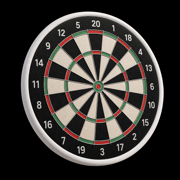
The parts of a dart, and what each one actually changes
The parts of a dart are the point, the barrel, the shaft, and the flight. The barrel holds nearly all the weight and is what you grip; the shaft and flight sit behind the center of gravity and do the steering. Change one part and you change one behavior.
The four parts of a dart, front to back
Point. The only part that touches the board. Steel points run roughly 25–41 mm, either fixed in the barrel or moveable; soft-tip points are plastic and consumable. Points add no aerodynamics — they decide penetration, whether a dart that clips a wire bites or deflects.
Barrel. The gripped section and most of the mass; shaft and flight add only a couple of grams. Material sets its diameter, profile sets where the mass sits front to back, and finish sets how much it drags on your fingers at release.
Shaft (or stem). Sets how far behind the center of gravity the flight sits. Length is the variable that matters; nylon, aluminum or carbon mostly affects durability and whether it works loose mid-session.
Flight. The four-vane tail that makes drag behind the center of gravity, pulling the tail into line with the point. Surface area is the variable; thickness and dimpled textures are second order.
The major steel-tip rulebooks cap a dart at 300 mm and 50 g, and nobody goes near either. Soft-tip sits far lower, around 16–20 g, because heavier darts chew through plastic tips and machine segments. If you haven't picked a format, steel tip versus soft tip is the real fork — the anatomy of a dart is identical, the weight conventions aren't.
Dart weight for beginners: why 21–26 g
Most steel-tip players land between 21 and 26 g, and 23–24 g is where most stock sets start. A very light dart carries little momentum against drag, so small differences in release speed move the impact point a long way. A very heavy dart holds its line well, then punishes your arm over a long session and drops steeply enough that you aim around it.
There's no best dart weight in the abstract — it's a match between the speed your throw naturally produces and the mass that flies flat at that speed. Fast, punchy throwers usually settle lighter; slow, lobbing throwers heavier. Buy a 23 or 24 g brass set, play it a month, and note whether your group sits high or low relative to where you aimed.
Tungsten and brass barrels: why slimmer groups tighter
Density. Brass sits around 8.5 g/cm³. A tungsten barrel isn't pure tungsten — it's a heavy alloy, tungsten mixed with a small amount of nickel and (depending on the maker) copper or iron, sold by its tungsten content: 80%, 90% and 95% are the usual grades. A 90% barrel lands near 17 g/cm³, roughly double brass.
Same weight, about half the volume. A 24 g brass barrel of typical length measures around 8 mm across; the tungsten equivalent comes in a bit under 6 mm. A treble bed is well under a centimeter wide, and darts two and three share it with dart one — fat barrels deflect off darts already in the board, slim ones fit. Nickel-silver behaves like brass, so the practical ladder is brass, then 80–90% tungsten, then 95% only when barrel diameter is what limits your grouping.
Dart barrel shapes and grip patterns
Barrel shape is mass distribution described in profile:
- Straight — uniform diameter end to end. Neutral balance, tolerant of where your fingers land.
- Torpedo (front-loaded) — thickest near the point, tapering rearward. Mass forward pulls the center of gravity forward and encourages a nose-first entry.
- Bomb or ton — bulges through the middle, so the widest point is a landmark for repeating the same finger position.
Grip texture is machined onto that shape: knurling (crosshatched, coarse, aggressive), ring or groove cuts (parallel bands, the most common), shark and scallop cuts (angled bite), and micro-etched finishes that are barely tactile. The failure mode is an over-gripped barrel: knurling sharp enough to catch your fingertips adds drag or rotation you don't need. If your darts fly clean when you throw softly and scatter when you throw hard, suspect the texture before the weight.
Dart shaft length and flight shapes: stability against drag
Two things set how strongly the flight corrects: its surface area, and shaft length — a longer shaft moves the flight further back, lengthening the lever and multiplying the effect.
Both increase stability, and both increase total drag, which slows the dart and steepens its drop. That's the trade, and it's why the standard pairings exist: a large flight with a short shaft, or a small flight with a long shaft. Shaft lengths sell as short, in-between, medium and long; the naming isn't standardized between brands, but the usable range runs roughly 35 mm to 55 mm. Dart flight shapes are easiest to read by surface area:
| Flight shape | Surface area | What it does | Suits |
|---|---|---|---|
| Standard (No. 2 / No. 6) | Largest | Strongest correction, most drag; flies slower, drops more at the end | Slower or lobbing throws |
| Kite | Large | A little less drag, still strongly self-correcting | Stepping down from standard |
| Pear | Medium | Middle ground; narrower profile, so darts crowd each other less | The common compromise |
| Slim | Smallest | Little correction, low drag, flat and fast | Hard throwers with a clean release |
A creased or split vane stops making symmetric drag and starts steering. Flights are cheap — swap them first when the flight path changes for no reason.
Which part to change first when your darts misbehave
If the group scatters in every direction at once, that's technique, and drilling your accuracy beats a new set. For the symptoms below, change one variable and give it a full session.
Nose-down and steep. Not enough rear drag is holding the tail back. Go up one flight size or one shaft length. The group lands slightly lower afterward, because the extra drag costs range, so re-aim before judging.
Wobble or fishtail. Check the flight first — a crease, split vane or loose seat costs nothing to rule out. If it's sound, wobble is usually release rather than hardware, most often a thumb dragging along the barrel, so review your throwing motion. A larger flight damps the wobble but masks the cause.
Bounce-outs. Look at the point. A needle-sharp tip can slide along a wire instead of biting; a blunted, mushroomed one won't penetrate. Dress it to a slightly rounded taper with a stone. If bounce-outs happen where a dart is already in the board, the answer is barrel diameter.
Comparing two setups honestly is hard — you remember the visits that worked and forget the ones that didn't. Play a full leg with setup A, a full leg with setup B, and compare the scores. Darts Scoreboard, a darts scoreboard app for iPhone that tracks your games, keeps the leg score while you swap sets.
FAQ
What are the four parts of a dart called?
Point, barrel, shaft and flight. The point contacts the board, the barrel carries the grip and most of the weight, the shaft positions the flight, and the flight makes the drag that pulls the tail into line.
What dart weight should a beginner start with?
23 or 24 g in a brass set. It's mid-range for steel tip, costs little, and buys you a month of evidence about whether you throw high or low before you spend on tungsten.
Does tungsten actually make you more accurate?
Not directly. Tungsten alloy is roughly twice as dense as brass, so the same weight becomes a slimmer barrel, and slim barrels let three darts sit closer together in a treble bed. It removes an obstacle rather than improving your throw.
How long should my dart shaft be?
There's no correct length on its own, only a correct pairing with a flight. Short shafts around 35 mm suit larger flights; longer shafts around 50–55 mm suit slim ones. Start medium and change length once you've settled on a flight shape.
Can I mix parts from different sets?
Mostly. Most modern steel-tip barrels use a 2BA thread, so shafts and flights swap between brands. Points are the exception — a fixed point can't be changed without a press, and soft-tip barrels aren't reliably interchangeable.
Free Darts tools
- Darts Checkout CalculatorUse this darts checkout calculator to find the best route from your score, see alternative finishes and choose a preferred double.
- Darts Cricket ScorerTrack every player's marks and points in a live darts cricket scoreboard, with open or closed numbers and the winner shown as the game develops.
- Darts Double Out ChartGenerate a complete darts double out chart from 2 to 170. Choose a preferred finishing double and print a route for every finishable score.
- Darts Match CounterA one-handed darts counter for live 301 and 501 matches. Enter each visit to see remaining scores, averages, checkout routes and leg or set state.
- Darts Score Chart CalculatorUse this darts score chart calculator to turn a selected board number and multiplier into the points scored, including valid outer and inner bull options.