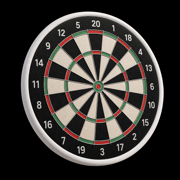
Dart board height and distance, measured properly
Regulation dart board height is 5 ft 8 in (1.73 m) from the floor to the center of the bull. The oche sits 7 ft 9¼ in (2.37 m) horizontally from the face of the board. Hung correctly, the diagonal from bull to throw line measures 9 ft 7½ in (2.93 m).
Regulation dart board height, distance, and diagonal
Every governing body that matters for steel tip — the World Darts Federation, the PDC, the American Darts Organization — works from the same three dart board measurements:
- Height: 1.73 m (5 ft 8 in), floor to the center of the bull.
- Throwing distance: 2.37 m (7 ft 9¼ in), horizontally from the face of the board to the back of the oche.
- Diagonal: 2.93 m (9 ft 7½ in), from the center of the bull to the back of the oche at floor level.
The WDF measures that height from the floor "at the same level as the Oche." If your floor slopes — cellars and converted garages usually do — the height under the board isn't the height under your feet, and your feet are what decide how the throw feels.
Measure the dart board distance from the face, not the wall
A bristle board is about 38 mm (1½ in) thick, and a cabinet pushes the face out further still. Measure 7 ft 9¼ in from the wall and you're an inch and a half short before the cabinet is counted — enough to move where the darts land. The rulebook method is a plumb line: drop a weighted string from the face of the board, mark the floor where it touches, and run the tape from that mark.
What a darts oche is
The oche — pronounced "ockey" — is the throw line. Under WDF rules it isn't a strip of tape but a raised bar, 38 mm high and 610 mm long (1½ in by 2 ft), and the 2.37 m is measured to the back of it, not the front.
Two rules govern your feet: you can't tread on the raised oche, and if you throw from off to one side you have to stay behind an imaginary line extending from its ends. Leaning over is legal — the rule binds your feet, not the rest of you. At home, tape works, though a raised bar tells your front foot where the line is without you looking down.
The diagonal check: 9 ft 7½ in
Height and dart board distance are separate measurements, so it's easy to get one right, get the other wrong, and never notice. The diagonal catches both at once: if the bull really is 1.73 m up and the oche really is 2.37 m out, Pythagoras forces the hypotenuse to 2.93 m. One tape pull from the center of the bull to the floor at the back of the oche settles it.
For squareness, run the tape from the bull to each end of the throw line. The two numbers should match. If they don't, the line isn't centered on the board and you're throwing across it at an angle — which shows up as a steady bias to one side of the treble.
Steel tip, soft tip, and wheelchair
| Setup | Height to center bull | Throwing distance | Diagonal |
|---|---|---|---|
| Steel tip (WDF, PDC, ADO) | 5 ft 8 in / 1.73 m | 7 ft 9¼ in / 2.37 m | 9 ft 7½ in / 2.93 m |
| Soft tip (NDA, North America) | 5 ft 8 in / 1.73 m | 8 ft / 2.44 m | ≈9 ft 9⅝ in / 2.99 m |
| Wheelchair | 4 ft 6 in / 1.37 m | 7 ft 9¼ in / 2.37 m | 9 ft / 2.74 m |
Soft tip's extra 2¾ inches is the biggest single source of arguments about how far to stand from a dart board. Both are real regulation distances; they belong to different games, and the height doesn't change between them. Only the steel-tip diagonal is written into the rules — the other two follow from it.
For wheelchair play the board comes down to 1.37 m (4 ft 6 in) to the bull, a height the WDF recognizes. The throwing distance stays at 2.37 m, which puts the diagonal at 9 ft (2.74 m), and the added rule is that both rear wheels of the chair must be behind the line. WDF rule 6.07 also lets member bodies amend board height and oche length for events for disabled players.
Hanging the board: wall, light, and clearance
- Fixing. A bristle board and bracket are heavier than they look — roughly 11 lb (5 kg). Hit a stud, or hang the board off a plywood panel screwed to the wall; drywall anchors alone work loose.
- Wall protection. Darts that catch a wire bounce out and land wide. A surround, a backing panel, or a cabinet absorbs them; bare plaster does not.
- Orientation. The board hangs flush to the wall, not tilted forward, with the 20 at top center — a black segment on a standard board. See dart board scoring values if you're still learning the layout. Rotate the number ring every few weeks so the treble 20 doesn't wear out ahead of everything else.
- Light. WDF rule 5.01 asks for a light fitting of at least 100 W per floor board, screened so it doesn't shine into the thrower's eyes; read the wattage as brightness, not a filament bulb. At home the real enemy is the shadow your own arm throws across the top of the board — a ring light, or two lights angled in from either side, clears it.
- Clearance. Allow around 11 ft of clear floor: the 7 ft 9¼ in of darts throwing distance, plus room to stand back off the oche. Keep at least 2 ft of clear wall on each side of the board.
Dart board measurements: the board itself
A WDF-approved board is 451 mm (17¾ in) across overall, with 340 mm (13⅜ in) of scoring area measured from the outside of one double wire to the outside of the double wire opposite. The bull is 12.7 mm across inside the wire, the 25 ring 31.8 mm, and the double and treble bands 8 mm inside to inside.
Test the setup with a scored leg
Once the tape agrees with the rulebook, throw a leg rather than a handful of casual darts. A scored 501 sends you to the 20 bed, out to the wider beds on the way down, and onto a double to finish — a better test of a new setup than throws at the bull. If you're new to the format, how to play darts covers the sequence and darts scoring covers the arithmetic. Darts Scoreboard is a darts scoreboard app for iPhone that tracks your games, so that first leg on a new board is recorded as a baseline to measure later sessions against.
FAQ
How far do you stand from a dart board?
7 ft 9¼ in (2.37 m) for steel tip, measured horizontally from the face of the board to the back of the throw line, or 8 ft (2.44 m) for soft tip. Your feet stay behind the line, but you can lean over it as far as your balance allows.
What is the dart board regulation distance measured from?
The face of the board — not the wall, and not the front of a cabinet. Drop a plumb line from the board face to the floor, mark the spot, and measure from there to the back of the oche.
Should I lower the dart board height for kids?
Organized youth darts is played on a standard board at 5 ft 8 in, so a child who wants to compete is better off learning at full height. For casual play nothing stops you dropping it — just accept the setup won't match any board they play on elsewhere.
Does the 20 have to be at the top of the board?
Yes. The 20 sits at top center, on a black segment on a standard board, and the board hangs flush rather than tilted forward. Players rotate the number ring to spread wear, but the 20 goes back on top before play starts.
Free Darts tools
- Darts Checkout CalculatorUse this darts checkout calculator to find the best route from your score, see alternative finishes and choose a preferred double.
- Darts Cricket ScorerTrack every player's marks and points in a live darts cricket scoreboard, with open or closed numbers and the winner shown as the game develops.
- Darts Double Out ChartGenerate a complete darts double out chart from 2 to 170. Choose a preferred finishing double and print a route for every finishable score.
- Darts Match CounterA one-handed darts counter for live 301 and 501 matches. Enter each visit to see remaining scores, averages, checkout routes and leg or set state.
- Darts Score Chart CalculatorUse this darts score chart calculator to turn a selected board number and multiplier into the points scored, including valid outer and inner bull options.