Cricket darts rules, scoring, and strategy
The cricket darts rules are short: seven targets are in play — 20, 19, 18, 17, 16, 15 and the bull. Three marks close a number, and a closed number pays you points until your opponent closes it too. You win by closing all seven with your points level or ahead.
Cricket darts rules: the seven numbers in play
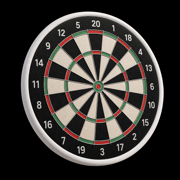
Cricket ignores most of the board. Only 15, 16, 17, 18, 19, 20 and the bullseye count — a dart in the 7 or the 12 is just a dart you don't get back. Each player throws three darts per turn and play alternates, so that's the whole setup for how to play cricket darts: six numbers, one bull, three darts a visit.
The throw itself is standard. A dart has to stay in the board to count; a bounce-out scores nothing and you don't get to throw it again. The board matters more here than in 501 and 301, because the doubles and triples of six specific numbers do all the work — know the scoring values on a dartboard cold first.
How to close a number: the three-mark rule
A "mark" is one hit on a cricket number. You need three marks to close it, and marks carry over from turn to turn — nothing resets between visits.
- Single = 1 mark
- Double = 2 marks
- Triple = 3 marks
So a number closes with three singles, a single plus a double, or one triple. A triple 20 with your first dart of the match closes the 20 outright.
Marks past the third aren't wasted. Sitting on two marks on 19 and throwing a triple, one mark closes the number and the spare two score 38 — provided your opponent still has 19 open.
The bull runs on the same scale in a different shape: the outer bull (25) is one mark, the inner bull (50) is two. Two darts in the inner bull is four marks — three to close it, one spilling over as 25 points. The tidy close is inner bull then outer, or three outers.
A maximum cricket visit is three triple 20s: nine marks, three of which close the 20 while the other six put 120 points on the sheet.
Reading the cricket scoresheet
The standard scoresheet is three columns. The numbers run down the middle, usually 20 at the top through 15 with a B for the bull at the bottom, though plenty of sheets write 15 at the top instead. Each player owns the column on their side, and their marks go beside each number.
The marks are drawn in a fixed order, which is why any player can read a stranger's sheet at a glance:
- First hit: a slash,
/ - Second hit: a stroke crossing it, making an
X - Third hit: a circle around the
X— the number is closed
Points sit in a running total at the outer edge of each player's column, rewritten as a new cumulative figure each time it changes rather than logged as separate additions.
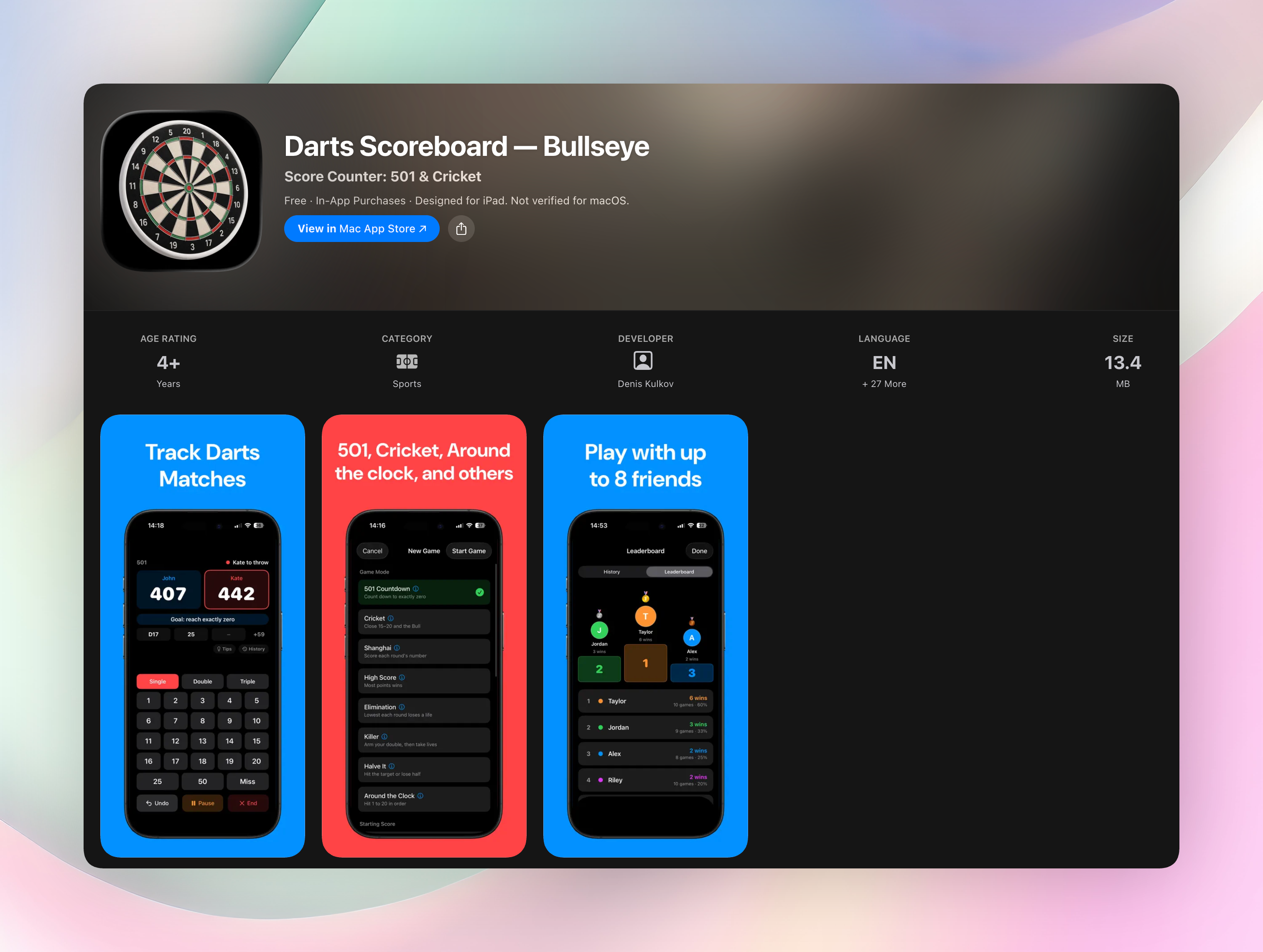
Paper holds up until the fourth leg, when the sheet is a smudge and someone's arguing about whether that circle was ever drawn. Darts Scoreboard is a darts scoreboard app for iPhone that tracks your games, keeping marks and points per player, so nobody has to redraw the slash-and-X grid between legs.
How to score cricket darts
Once you've closed a number and your opponent hasn't, every further mark on it scores its face value. Three more 20s after closing is 60 points. A triple 19 after closing 19 is 57. The bull pays 25 for an outer and 50 for an inner.
The window shuts the moment your opponent closes that number too. From then on it's dead — nobody scores on it, and it sits there with a circle on both sides of the sheet. That's what makes cricket darts scoring feel nothing like standard darts scoring, where a 60 is a 60 regardless of what your opponent has done.
The practical effect: close early enough to open a window, hammer that number while it's open, and close the rest before your opponent runs the same play back at you.
Winning: all seven closed and points equal or ahead
You win the instant both of these are true:
- All seven numbers are closed on your side.
- Your point total is equal to or higher than your opponent's.
Miss either and the game keeps going. Closing everything while trailing by 90 is the classic way to lose. If you're behind, closing your last number wins nothing — play continues and you still have to make up the gap on whatever your opponent left open. Spend those darts on a number you've closed and they haven't, catch up, then close last.
The mirror case bites too. A big points lead with three numbers still open is not a lead; every visit you spend closing is a visit they spend scoring.
Cut throat cricket darts rules
Cut throat inverts the points. It's the usual pick with three or four players, though nothing stops two people playing it.
When you score on a number you've closed, the points don't come to you. They're added to every opponent who still has that number open. Hit a triple 20 with your own 20 closed and two opponents still open on it, and each of them takes 60. Lowest score wins.
Two things follow. Closing becomes defense — once a number is circled on your side, nobody can load points onto you there. And the cleanest scorer is the player everyone else targets, so the field gangs up on the leader. The win condition mirrors standard cricket: close all seven while holding the lowest, or tied-lowest, score.
No-score cricket
Take the points out completely. First player to close all seven numbers wins, and that's the entire rule set. It's the quickest version and the easiest to teach, since there's no arithmetic to argue about.
| Variant | Who takes the points | Win condition | Typical players |
|---|---|---|---|
| Standard cricket | You, while an opponent has the number open | Close all seven, points equal or ahead | 2 players or 2 teams |
| Cut throat | Every opponent still open on that number | Close all seven, lowest or tied-lowest score | 3–4 |
| No-score | Nobody — points aren't kept | Close all seven first | Any |
Cricket darts strategy: close 20 and 19 first
The usual order of business, and why:
- Open 20, then 19. They're the highest-value numbers, so every mark past the third is worth 20 or 19 instead of 15. A player who opens at 15 and works up hands the 20 to their opponent.
- Point before you move on. Don't switch to 18 the second your 20 is closed if your opponent still has 20 open. Darts thrown at an open scoring window are the most valuable in the game.
- Close what's bleeding you. If they've closed 20 and you haven't, a good visit from them costs you up to 180. Closing your 20 earns nothing directly, but shutting off 180 a visit beats three marks somewhere quiet.
- Don't park the bull at the end by reflex. For most players it's the hardest of the seven to hit, so someone who needs only the bull can stall for four or five turns while the opponent closes back and out-points them. If you're steady at the bull, bank a mark early.
- Watch for dead numbers. A number your opponent closed before you did is worth nothing except the win condition. Close it, but never spend a whole visit there.
FAQ
What numbers do you use in cricket darts?
15, 16, 17, 18, 19, 20 and the bullseye — seven targets. Everything from 1 to 14 is dead board. The doubles and triples of those six numbers count as two and three marks respectively.
How many marks does it take to close a number?
Three. A single is one mark, a double is two and a triple is three, so a number can go from open to closed with one dart. Marks accumulate across turns and never reset.
Does the bullseye count as one mark or two?
Both, depending on where you hit. The outer bull (25) is one mark and the inner bull (50) is two, so the bull can close in two darts. Once closed it pays 25 or 50 points per hit while your opponent still has it open.
Can you win cricket if you've closed everything but you're losing on points?
No. Both conditions have to be true at the same moment — all seven closed and points equal to or greater than your opponent's. Close out while behind and play continues, with only your opponent's remaining open numbers available to score on.
How do you keep score in cricket darts on paper?
Three columns: the numbers down the middle, one player per side. One hit is a slash, two is an X, three is a circle around the X. Keep a running cumulative points total at the outer edge of each player's column.
Free Darts tools
- Darts Checkout CalculatorUse this darts checkout calculator to find the best route from your score, see alternative finishes and choose a preferred double.
- Darts Cricket ScorerTrack every player's marks and points in a live darts cricket scoreboard, with open or closed numbers and the winner shown as the game develops.
- Darts Double Out ChartGenerate a complete darts double out chart from 2 to 170. Choose a preferred finishing double and print a route for every finishable score.
- Darts Match CounterA one-handed darts counter for live 301 and 501 matches. Enter each visit to see remaining scores, averages, checkout routes and leg or set state.
- Darts Score Chart CalculatorUse this darts score chart calculator to turn a selected board number and multiplier into the points scored, including valid outer and inner bull options.