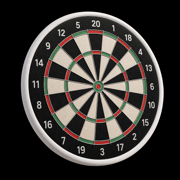
The history of darts and the dartboard
The history of darts starts with shortened arrows thrown at a beer-barrel end or a sawn section of tree trunk in English pubs. The board's wedges and rings copy that wood. The standard numbering is credited to Brian Gamlin in 1896 — though no record of the man survives.
The history of darts begins with shortened arrows
"Dart" meant a small throwing arrow long before it meant a pub game. The darts origin story: drinkers and soldiers throwing cut-down arrows at the bottom of an upturned cask, or at a felled tree's cross-section. The log end explains the board better: it dries with radial cracks and growth rings, so the wedges and rings existed before anyone designed them.
Early boards were elm or poplar, soaked overnight — often in beer — so the wood swelled and closed the previous night's holes. That was what dartboards were made of until the 1930s.
The 1908 Leeds case that made darts a game of skill
Edwardian licensing law split games of skill from games of chance, and chance games were illegal in a pub. In 1908, a Leeds landlord — usually named as "Foot" Anakin of the Adelphi Inn — was summoned for allowing darts on the premises. He's said to have had a board carried into court, thrown three darts into the 20, and watched a clerk miss it completely. The summons was dismissed, and darts was ruled a game of skill.
The courtroom detail comes from later darts writing, not a surviving transcript — treat the demonstration as a story and the ruling as fact.
Why are dartboard numbers in that order?
Clockwise from the top: 20, 1, 18, 4, 13, 6, 10, 15, 2, 17, 3, 19, 7, 16, 8, 11, 14, 9, 12, 5.
The layout punishes proximity: fat numbers sit next to thin ones, so a near-miss loses most of the value. Miss the 20 either side and you score 1 or 5; miss the 19, 3 or 7; miss the 18, 4 or 1.
The protection is uneven, and that's the point. The 20's neighbors total 6, the 19's total 10, the 16's total 15 — why players drop from the 20 to the 19 when their grouping goes, and to the 16 for a cheaper miss. All twenty numbers add up to 210, high alternating with low all the way around.
Who designed the dartboard?
Brian Gamlin, a Bury, Lancashire carpenter, is credited with the arrangement in 1896 — usually said to have died in 1903 before he could patent it. Researchers have hunted him through public records without success, so the credit is traditional, not documented. A competing claim gives the modern board to Thomas William Buckle of Dewsbury, around 1913, who added a treble ring to the Yorkshire pattern.
The regional boards the clock board replaced
Before one board won, which wall you played depended on where you drank.
| Board | Beds | Treble ring | Notes |
|---|---|---|---|
| Standard "clock" | 20 | Yes | Doubles, trebles, inner and outer bull |
| Yorkshire | 20 | No | Same numbering, no treble ring, no outer bull |
| London Fives | 12 | No | Only 20s, 5s and 15s, so every score divides by five |
| Manchester "log end" | 20 | No | Small elm board, doubles only, its own numbering |
National competition ended that. The News of the World Individual Darts Championship — first run around London in the late 1920s, expanded nationwide after the Second World War — needed a single board and rule set, and the clock board was already the most played.
Standardization and the televised era
The playing surface changed in the 1930s, when Nodor produced the first sisal "bristle" board. Sisal fibers close behind the dart instead of splitting, so boards stopped needing a nightly soak and lasted seasons. Governing bodies fixed the geometry every league still uses: a 7 ft 9¼ in (2.37 m) throw to a bull 5 ft 8 in (1.73 m) off the floor — the dartboard height and distance you set up to today.
Television did the rest. Yorkshire Television's The Indoor League put pub games in front of a national audience from 1972, the British Darts Organisation formed in 1973, and the first world professional championship was played in 1978. A split in the early 1990s created the rival body behind today's biggest events.
Those decades also fixed the scoring you still play: 501 and 301 down to a double, a running total chalked beside the board, doubles and trebles scored the way they were in the 1930s. If you'd rather not do the subtraction in your head, Darts Scoreboard is a darts scoreboard app for iPhone that tracks your games.

Documented history, and pub folklore
Dartboard history carries a lot of unsourced claims, so it's worth sorting them.
- Documented: the regional boards and layouts, the 1930s sisal board, the News of the World competition, the 1970s television expansion, the modern dimensions.
- Traditional but unproven: Gamlin as the man who designed the dartboard, the 1908 demonstration's details, Buckle's 1913 claim.
- Folklore: Anne Boleyn's ornate darts for Henry VIII, Mayflower passengers playing mid-crossing, Agincourt archers inventing the game from broken arrows — repeated everywhere, supported by nothing.
FAQ
Who invented darts?
No single person. Darts grew out of throwing shortened arrows at wooden targets in nineteenth-century English pubs, and the earliest references treat it as an established pastime, not new. Credit attaches to pieces of it — the numbering, the treble ring, the bristle board — never to the game itself.
Why is the 20 next to the 1 and the 5?
To make a narrow miss expensive. A dart a few millimeters wide of the treble 20 scores 1 or 5 instead of 60, forcing real accuracy instead of aiming at the top of the board.
How old is the dartboard you play on?
By tradition the numbering dates to the 1890s and the treble ring to the early 1900s; the sisal playing surface followed in the 1930s. A modern board is essentially that 1930s design in better materials.
When did darts become a televised sport?
The 1970s. The Indoor League showed pub darts from 1972, the British Darts Organisation formed in 1973, and the first world professional championship followed in 1978.
Free Darts tools
- Darts Checkout CalculatorUse this darts checkout calculator to find the best route from your score, see alternative finishes and choose a preferred double.
- Darts Cricket ScorerTrack every player's marks and points in a live darts cricket scoreboard, with open or closed numbers and the winner shown as the game develops.
- Darts Double Out ChartGenerate a complete darts double out chart from 2 to 170. Choose a preferred finishing double and print a route for every finishable score.
- Darts Match CounterA one-handed darts counter for live 301 and 501 matches. Enter each visit to see remaining scores, averages, checkout routes and leg or set state.
- Darts Score Chart CalculatorUse this darts score chart calculator to turn a selected board number and multiplier into the points scored, including valid outer and inner bull options.