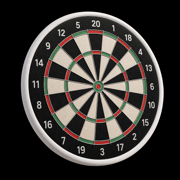
Nine dart finish: the perfect leg, explained
A nine dart finish is a leg of 501 won with nine darts, the fewest the game allows. The ninth dart has to land in a double, so the eight before it have to be near-maximum scores. The most common route is 180, 180, then a 141 checkout.
Why a nine dart finish can't happen in eight darts
One dart scores 60 at most, in the treble 20. Eight darts at 60 apiece is 480 — 21 short of 501 — so no leg can end in eight. Nine darts allow 540, so nine is the first number that works.
The second constraint is the double. Most 501 — PDC televised play and the bulk of league darts — is straight-in, double-out: you can start scoring in any bed, but the leg has to end in a double or the bullseye, which counts as double 25. The 501 and 301 rules cover the variants. So you don't just need eight monster darts, you need them to leave a number you can actually kill.
Only six doubles can end a perfect leg
Work it backwards. Your first eight darts top out at 480, so the ninth is left with at least 21, and that alone rules out double 1 through double 10.
The arithmetic thins the field further. Whatever you fall short of a perfect 480 has to be built from the gaps between 60 and whatever else you hit: treble 19 is 3 short, treble 18 is 6, treble 17 is 9, the bull is 10, treble 16 is 12. Some shortfalls can't be assembled at all — double 11 needs 1, double 13 needs 5, double 14 needs 7, double 16 needs 11, double 19 needs 17, and none of those are makeable.
Six finishes survive: double 12, double 15, double 17, double 18, double 20 and the bullseye. Double 12 is the one you see most, because it's the tail of the 141 that sits there after back-to-back maximums.
The routes that make 501 in 9 darts
| Last double | Visit 1 | Visit 2 | Visit 3 | Scores |
|---|---|---|---|---|
| Double 12 | T20 T20 T20 | T20 T20 T20 | T20 T19 D12 | 180 / 180 / 141 |
| Double 15 | T20 T20 T20 | T20 T20 T20 | T20 T17 D15 | 180 / 180 / 141 |
| Double 17 | T20 T20 T20 | T20 T20 T20 | T19 bull D17 | 180 / 180 / 141 |
| Double 18 | T20 T20 T20 | T20 T20 T20 | T17 T18 D18 | 180 / 180 / 141 |
| Double 20 | T20 T20 T20 | T20 T20 T20 | T17 bull D20 | 180 / 180 / 141 |
| Bullseye | T20 T19 bull | T20 T19 bull | T20 T19 bull | 167 / 167 / 167 |
Five of the six hang off the same 141, which has other outs too — T20 T15 D18, T18 T17 D18, T19 bull D17. Two 180s is the common road in because players are aiming at treble 20 anyway; the route needs no detour.
You don't need two maximums either: 180, then 177 from T20 T20 T19, leaves 144 for T20 T20 D12.
Double-in formats rewrite the problem. At the World Grand Prix the opening dart must land in a double, which caps it at 50 and rebuilds every route. Brendan Dolan threw the first nine-darter in that format at the 2011 Grand Prix, against James Wade: 160, 180, and a 161 finish on the bull.
Knowing when you're three darts away
Two maximums and you're sitting on 141, one visit from the perfect leg — and that's the moment nobody at the oche is doing reliable mental subtraction. The only way to know is a live remaining total after every turn. Darts Scoreboard is a darts scoreboard app for iPhone that tracks your games, so the number in front of you stays current.
The odds of a nine dart finish, club night versus pro tour
Per-bed hit rates aren't officially tracked, so plug in plausible numbers. Take the 180-180-141 route and assume a top professional lands treble 20 with 40% of darts, treble 19 with 30% and double 12 with 40%. Seven treble 20s at 40% is about one in 610 on its own; add the treble 19 and the double and you're near one leg in 5,000. Multiply by the thousands of legs a tour player throws in a year and it stops looking freakish.
Run the same sum for a strong club player — 15% on treble 20, 12% on treble 19, 25% on double 12 — and it lands near one leg in 20 million. At thirty legs a week that isn't a career, it's geology. Club nine-darters do happen, which is why they make the local paper.
180, 170 and the highest darts average
180 is the highest score in darts from a single three-dart visit: three treble 20s. 170 is the highest checkout — treble 20, treble 20, bullseye, the shot everyone calls the big fish. Just below it sit the bogey numbers, which can't be taken out in three darts at all: 169, 168, 166, 165, 163, 162 and 159. Any darts out chart shows those gaps.
Averages run on the same arithmetic. A three-dart average is points scored divided by darts thrown, times three, so a 100 average means clearing 501 in about 15 darts. The highest darts average possible in a single leg is 167, exactly what a nine-darter returns: 501 points from nine darts. Across a full match the best darts average figures land well below that ceiling; one scrappy leg drags it down.
FAQ
What is a 9 dart finish?
A leg of 501 won in nine darts, the minimum the game allows. Eight maximum darts only reach 480, and the ninth has to land in a double, which is why nine is the floor. Players also call it a perfect leg.
What is the highest score in darts?
180, from three treble 20s in one visit. The highest checkout — the biggest number you can finish from with three darts — is 170: treble 20, treble 20, bullseye.
Can 501 be finished in fewer than nine darts?
No. Eight treble 20s score 480, twenty-one short, and the final dart must be a double. Nine is a hard floor in 501, straight-in or double-in.
What is the highest darts average possible?
167 over a single leg, which is what a nine-darter produces. Match averages sit lower because most legs take more than nine darts; 100 across a match is a strong professional showing, past 110 exceptional.
Has a nine-darter been thrown on television?
Many times. The first came from John Lowe against Keith Deller at the MFI World Matchplay in October 1984 — two 180s, then 141 taken out with treble 17, treble 18, double 18 — and it carried a £102,000 prize. They are now hit several times a season on the pro circuit.
Free Darts tools
- Darts Checkout CalculatorUse this darts checkout calculator to find the best route from your score, see alternative finishes and choose a preferred double.
- Darts Cricket ScorerTrack every player's marks and points in a live darts cricket scoreboard, with open or closed numbers and the winner shown as the game develops.
- Darts Double Out ChartGenerate a complete darts double out chart from 2 to 170. Choose a preferred finishing double and print a route for every finishable score.
- Darts Match CounterA one-handed darts counter for live 301 and 501 matches. Enter each visit to see remaining scores, averages, checkout routes and leg or set state.
- Darts Score Chart CalculatorUse this darts score chart calculator to turn a selected board number and multiplier into the points scored, including valid outer and inner bull options.