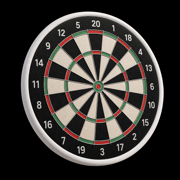
Darts scoreboard rules and how to chalk a game
Darts scoreboard rules are simple: each player gets a pair of columns, the starting total sits at the top, and every visit you write the score thrown next to the new remaining score. The bottom number is always what that player needs. The chalker calls the score only after all three darts land.
How a darts scoring board is laid out
A pub chalkboard is one rectangle split down the middle, one half per player, each half divided into two narrow columns. Names or initials go across the top. The starting total — 501 in most league and pro play, 301 in shorter formats — is written once at the head of each remaining column.
On most boards the halves mirror each other: the score thrown sits in the outer column, the running remainder in the inner one, so both remainders end up side by side against the center line. That's the point: you read the leg off the middle of the darts scoring board without adding anything up. Printable darts score sheets sometimes run thrown-then-remaining left to right instead; either way, agree the reading before the first dart.
Darts scoreboard rules for a 501 leg
A standard leg is 501, straight in, double out; each visit is three darts unless the player checks out early. The chalker writes the visit total, subtracts it, and puts the new remainder on the line below.
| Player A thrown | A remaining | B remaining | Player B thrown |
|---|---|---|---|
| — | 501 | 501 | — |
| 60 | 441 | 421 | 80 |
| 100 | 341 | 281 | 140 |
| 140 | 201 | 141 | 140 |
| 85 | 116 | 81 | 60 |
| 76 | 40 | 81 | bust |
| 40 | 0 | 81 | — |
Three things bust a visit under double-out rules: scoring more than the remainder, leaving exactly 1, or reaching zero on anything but a double or the inner bull (double 25). A bust scores nothing, so the chalker writes the same remaining number again on the next line — which is why B's 81 never moves. Formats vary at both ends: some house and soft-tip leagues play straight-out or master-out, and some older rule sets play double-in. Settle that before the first leg, not after somebody lands a single 20 on 20.
The rest of the darts scoring system — trebles, doubles, the 25 and 50 rings — feeds this one column of subtraction. If you're learning finishes, keep a darts checkout chart by the board rather than asking the chalker.
What the chalker calls, and when
Most chalking rules are about timing.
- Wait until all three darts are in the board or on the floor. Calling a dart mid-visit puts the thrower off and is the fastest way to get replaced.
- Call the score thrown, not the remainder: "eighty-one," then write it.
- Say "no score" on a zero. Say "bust" clearly, then repeat the number the player is back on.
- If a player asks what's left, give the total. "Thirty-two," never "double sixteen" — naming the double is coaching. Professional referees hold the same line: they call 36, not double eighteen.
Conventions differ on the remainder: televised referees announce it once a player is inside a three-dart finish, some leagues want it every visit, others leave it on the board. Ask first.
Chalking etiquette at the board
Stand clear of the thrower's eyeline and stay still while darts are in the air. Don't pull anyone's darts, and don't write so small that the player at the oche has to walk up and read it. Correct a figure by crossing it out and writing the new one beside it rather than wiping — the trail settles an argument three visits later.
The correction window belongs to the thrower. Under the standard rule sets it's the player's job to check the score before pulling their darts out of the board; once a dart has been removed, the figure stands even if it's wrong. That's why darts stay in until the number is agreed.
Marking cricket on the same board
The same board handles cricket with a different layout: 20, 19, 18, 17, 16, 15 and B down a narrow center column, with a player column on each side. A first hit is a slash, a second makes it an X, a third circles the X — that number is closed. Doubles count as two marks, trebles as three; on the bull, the outer ring is one mark and the inner is two. Points go in the outer columns once you've closed a number and the opponent hasn't. The rest of the cricket darts rules don't change how you mark, only what the marks are worth.
Three or more players
Keeping score in darts for three or four players is the same board with narrower columns. Give everyone a remainder column; if space is tight, drop the thrown columns and write each visit total small above it. Set the throwing order left to right and keep it between legs.
Chalking mistakes that wreck a leg
- Carried arithmetic. Every row builds on the one above, so one bad subtraction poisons the rest of the leg.
- Writing the visit total in the remainder column. Easy to do when the two numbers look alike — 140 next to 141.
- Subtracting a bust. The score is void, not partial.
- Writing a zero as a checkout. Under double-out, reaching zero on a single or a treble is a bust, not a win.
- Losing the throw. The starter alternates each leg. Mark it with an arrow before the first dart.
Chalking is the one job at the board that doesn't come with a throw, and somebody always ends up doing it instead of playing. Darts Scoreboard is a darts scoreboard app for iPhone that tracks your games, so both columns stay current without anyone sitting out to keep them.

FAQ
What do the columns on a darts scoreboard mean?
One column holds the total scored on each visit, the other what's left after subtracting it. The lowest number in the remainder column is what that player is throwing at.
Can the chalker tell you what you need?
Yes, if you ask, but only as a total. The chalker says "thirty-six," not "double eighteen," because naming a finish is advice rather than scoring.
What happens if the chalker writes down the wrong score?
Say so before you pull your darts and it's a non-issue — they're still in the board to prove the number. Once they're out, the recorded score generally stands under standard league and tournament rules. That's why the caller repeats every number out loud.
How do you score a game of darts without a board?
A darts scoring sheet works the same way on paper: a column per player, the starting total at the top, visit total and remainder on each line. Rule a page into columns or print one out. The arithmetic and the double-out finish don't change.
Free Darts tools
- Darts Checkout CalculatorUse this darts checkout calculator to find the best route from your score, see alternative finishes and choose a preferred double.
- Darts Cricket ScorerTrack every player's marks and points in a live darts cricket scoreboard, with open or closed numbers and the winner shown as the game develops.
- Darts Double Out ChartGenerate a complete darts double out chart from 2 to 170. Choose a preferred finishing double and print a route for every finishable score.
- Darts Match CounterA one-handed darts counter for live 301 and 501 matches. Enter each visit to see remaining scores, averages, checkout routes and leg or set state.
- Darts Score Chart CalculatorUse this darts score chart calculator to turn a selected board number and multiplier into the points scored, including valid outer and inner bull options.