Darts tips to hit more trebles and finish more legs
Most darts tips that matter have nothing to do with your grip. Aim at the treble bed rather than at the number, learn six finishes cold instead of memorizing a whole chart, and spend most of your practice on the last three darts of a leg — that's where legs are lost.
All of it assumes your throw already repeats. If the darts still land in three different postcodes, fix the throwing action first — no strategy rescues a stroke that changes every visit.
Darts tips for scoring: aim at the bed, not the number
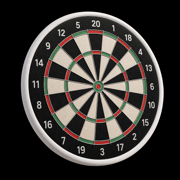
Most darts tips for beginners stop at "aim for the treble 20," which is advice about a number. Players who score aim at a strip of board about 8 mm deep — the treble bed, the only part of the 20 that pays what you came for.
The 20 wedge, from the edge of the outer bull to the outside edge of the double, runs a little over 150 mm. Eight of those millimeters score 60, another eight score 40, and everything else in the wedge scores 20. Aim at "the 20" and you're aiming at a target that's mostly worth a third of a treble.
Then read your misses. Grouped low, in the single 20 between the treble and the bull, means you're on line and short — the good miss. Grouped in the 5 and the 1 means sideways spread, which is stance or alignment, not aim. Scattered up and down the whole wedge means you aren't repeating the throw yet, and no drill fixes that.
One darts strategy worth trying if the misses stay sideways: move to the 19s. T19 is 57 rather than 60, but 19 sits between 7 and 3 instead of 5 and 1, so a wide dart lands on a bigger number. Plenty of good players stay on the 19s for good.
Learn six checkouts before you learn sixty
Full out charts run to hundreds of combinations, and trying to absorb them all is how people end up frozen on 87. Six doubles cover most finishes you'll face at club level:
- 40 → D20, the finish that comes up most
- 32 → D16, the one that halves cleanly: hit a single 16 and you're on 16, then 8, then 4, then 2
- 36 → D18
- 24 → D12
- 20 → D10
- 16 → D8
Above 40, learn the shape rather than the table. From an odd score, take off an odd single to leave an even one — 57 is 17 then D20, 45 is 13 then D16. From an even score under 100, throw the treble that leaves one of your six: 96 is T20 then D18, 81 is T19 then D12, 68 is T16 then D10.
Read a full darts out chart once anyway, for the bogey numbers: 159, 162, 163, 165, 166, 168 and 169 can't be finished in three darts whatever you hit, and neither can anything above 170. Never leave yourself on one. The highest three-dart checkout is 170 — T20, T20, bull.
Practice finishing, not scoring
A leg of 501 is decided in its last three darts far more often than its first three. Two players averaging 60 trade scores all night and arrive at a double at roughly the same time; the one who takes out 40 first wins. The short answer to how to win at darts more often isn't a bigger score — it's converting the finish you were handed.
Yet most solo practice is 501 against nobody, where nearly every dart goes at the treble 20 and only the last two or three go at a double. Flip the ratio: two darts at finishes for every one at the 20. Scoring comes along anyway, since every finishing drill still makes you land a treble first.
Four darts practice drills with target numbers
Darts practice routines only work if they produce a number you can beat next week. Write it down every time.
Around the clock
Hit 1 through 20 in order, then the bull. Singles count. Record the total darts thrown. It stops you camping in the 20 bed and exposes the segments you're quietly bad at, which often sit on one side of the board. A lap under 60 darts is a decent night. Hard version: trebles only.
121, ten times
Start at 121, throw until you check out, count the darts, repeat ten times. 121 has a clean three-dart route — T20, T11, D14 — and a bull route, T20, 11, bull, if you'd rather finish on 50. Which you pick matters less than the constraint: a live finish with a setup dart, not an empty board. Sixty darts for the ten finishes is a solid session.
Doubles round the board
D1 through D20, three darts at each, one pass. Record hits out of 60. This is the drill that tells you the truth, and the first honest count is usually lower than players expect. Whatever you score is your baseline — track it weekly. It moves faster than your scoring average, because doubles get the least practice.
Bob's 27
The classic doubles gauntlet. Start on 27 points. Throw three darts at D1: each hit adds its value, 2 points a dart, and missing all three subtracts what three hits would have been worth, 6. Then D2, D3, on up to D20, finishing with three darts at the bull, where each hit is worth 50 and missing all three costs 150.
Rules vary on the death condition — some play that dropping below zero ends the round there, others let you run negative and play for the final score. Reaching the bull alive is the first goal, finishing positive the second, anything over 100 a good night. It punishes exactly the weakness that loses legs: three darts at one double, no second chances.
What a three-dart average actually means
The average is total points scored divided by darts thrown, times three. Take 501 out in 15 darts and you averaged 100.2; in 30 darts, 50.1. It counts every dart, including the four you threw at D20 and missed, which is why an occasional 180 barely moves it and a bad night on the doubles wrecks it.
| Three-dart average | Darts to finish a 501 leg | Roughly where that puts you |
|---|---|---|
| Around 40 | ~38 | New player still learning the board |
| 50–60 | 25–30 | Regular pub or social player |
| 65–75 | 20–23 | Solid league player |
| 80–90 | 17–19 | Top of a strong league, county standard |
| 95+ | 16 or fewer | Professional tour level |
Expect the number to climb quickly for a few months, then stall somewhere in the 60s. That stall is nearly always doubles.
Progress only counts if it's written down, because memory rounds everything toward whatever you did last. A notebook works. Darts Scoreboard is a darts scoreboard app for iPhone that tracks your games, so the average from a month of legs is there to compare against the month before.
FAQ
How to get better at darts fast?
Move practice time from scoring to doubles. Plenty of players below a 60 average already land enough trebles to win legs and lose them on the last three darts instead. Two weeks of doubles round the board and Bob's 27 shows up in results faster than two weeks of 501.
What should I aim at if my darts keep landing in the 5 and the 1?
Sideways spread is a body problem, not an aiming problem. Check that feet, hips, shoulder and elbow line up on one target line, and film a few throws from behind. Aiming further left to compensate just moves the scatter.
How long should a darts practice session be?
Count darts, not minutes. Three hundred focused darts beat two hours of half-attention, and once the grouping falls apart you're rehearsing a worse throw than you arrived with. Several short sessions a week beat one long one.
What's a good three-dart average for a beginner?
Around 40 is normal after a few months, roughly 38 darts for a 501 leg. Sixty is a respectable club standard, and anything above 80 puts you near the top of most local leagues.
Free Darts tools
- Darts Checkout CalculatorUse this darts checkout calculator to find the best route from your score, see alternative finishes and choose a preferred double.
- Darts Cricket ScorerTrack every player's marks and points in a live darts cricket scoreboard, with open or closed numbers and the winner shown as the game develops.
- Darts Double Out ChartGenerate a complete darts double out chart from 2 to 170. Choose a preferred finishing double and print a route for every finishable score.
- Darts Match CounterA one-handed darts counter for live 301 and 501 matches. Enter each visit to see remaining scores, averages, checkout routes and leg or set state.
- Darts Score Chart CalculatorUse this darts score chart calculator to turn a selected board number and multiplier into the points scored, including valid outer and inner bull options.