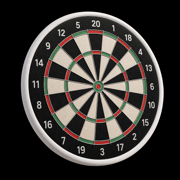
How to throw darts: the four parts of a repeatable throw
A dart throw has four parts: stance, grip, an elbow hinge with the upper arm locked, and a follow-through that ends with your fingers pointing at the target. Everything else stays still. That is most of how to throw darts well; the rest is repeating it.
Darts stance: a platform that doesn't move
On a steel-tip setup the throw line sits 7 ft 9¼ in (2.37 m) from the face of the board, measured horizontally, and the bullseye hangs 5 ft 8 in (1.73 m) off the ground. Soft-tip and electronic boards keep the same height but push the line back to 8 ft (2.44 m). Before you rebuild your arm, confirm the board height and oche distance are right. A board hung two inches low pulls every dart the same way and feels exactly like a technique fault.
Most players lead with the foot on their throwing side, toe behind the front edge of the oche, weight carried over that front leg. The back foot balances; it doesn't push. Leaning out over the line is allowed — putting any part of your foot on or past the front edge is not.
| Stance | Why players use it | Trade-off |
|---|---|---|
| Side-on, torso perpendicular to the line | Shortest reach to the board, very stable side to side | Loads one hip and the lower back over a long match |
| Angled, around 45° | The usual compromise: reach stays short, hips stay comfortable | Easy to let the shoulder rotate open without noticing |
| Front-on, square to the board | Feels natural, eyes level, weight simple to balance | The arm works across the body; you stand farther from the board |
None of the three is correct in the abstract. The test is whether you can hold yours for a full leg without your feet migrating. Mark the floor at your front toe and check it every few visits — a darts stance that drifts an inch moves the aiming line as surely as a bad grip does.
Darts grip: firm enough to hold, loose enough to let go
Balance the dart across one finger to find its center of gravity. That is roughly where the grip belongs: thumb just behind the balance point, index finger and one or two others in front of it. Three-finger and four-finger grips are both standard; five is uncommon rather than wrong. What matters is that the same fingers touch the same places every throw.
Pressure is where most players go wrong. Hold the dart firmly enough that it doesn't shift when you draw back, and no firmer. White fingertips or tension you can feel in the forearm mean you're squeezing. A tight darts grip doesn't only tire the hand, it delays the release, because clamped fingers have to actively let go instead of simply opening.
Set the tip level or slightly upward at address. Steel-tip barrels commonly run 21–26 g, and WDF and PDC rules cap a dart at 50 g and roughly 300 mm. Soft-tip is a separate code: barrels usually run 16–20 g, and leagues and machine makers cap weight far lower — often around 18–21 g, with a 16.8 cm length limit — to spare the board. Heavier darts feel more forgiving of a rough release, lighter ones quicker off the fingers. Neither fixes a throw.
How to aim in darts: one eye, one line
Find your dominant eye first. Make a small triangle with both hands at arm's length, frame a distant object through it with both eyes open, then close one eye at a time. The eye that keeps the object framed is the dominant one.
Aiming puts three things in a single vertical plane: dominant eye, dart tip, target. Bring the dart to the same setup point on every throw, usually somewhere between the corner of the eye and the chin, so that plane is identical each time. Then watch the target rather than the dart. Following the dart in flight pulls your head off line before the release.
Aim at a point, not an area. "Treble 20" is not a target; the left wire of the treble 20 is. Knowing what each bed on the board is worth also tells you where a miss is cheap. Landing in the 5 or the 1 is the standing cost of aiming at the 20, which is why players who scatter low and left often move to the 19s for a while.
How to throw darts: hinge, release, follow through
Set the upper arm and leave it there. The elbow is the hinge and the forearm is the only part that swings. Some players draw the dart straight back toward the face, others barely draw at all. Both work at the top level. The non-negotiable is that the upper arm stays where you put it until the dart is gone.
Accelerate smoothly through the forward swing. The release isn't timed consciously; it happens as the forearm comes through and the fingers open. Then keep going — the arm extends toward the board and finishes with the fingers pointing at your target, the elbow rising only after the dart has left.
Hold the same rhythm across all three darts. Rushing the third after two good ones is the most common way a visit falls apart.
Three faults that cost the most points
Dropping the elbow. The upper arm collapses downward mid-throw, so the dart leaves on a falling line and lands low. Some professionals do drop the elbow and still score heavily, so treat a still upper arm as a strong default rather than a law. If your darts group below the target instead of around it, check this first.
Squeezing the barrel. Excess grip pressure travels up the forearm and makes the release late and inconsistent. The tells are sore fingertips and groups that spread vertically for no reason you can see.
Cutting the follow-through short. Stopping the arm at release means you were already decelerating before it, and deceleration steers. Darts pull left or right at roughly the same height. Hold the finish for a beat, fingers out toward the board, until it stops feeling strange.
All three hide behind "the darts felt fine." None of them feels like anything, which is the trouble with judging darts throwing technique from inside your own arm.
Test a change over a scored leg, not by feel
Change one variable at a time, grip pressure or foot position but never both, then play a full 501 leg and work out your three-dart average: total scored, divided by darts thrown, times three. Darts Scoreboard is a darts scoreboard app for iPhone that tracks your games, so the legs from before and after a change are still there to compare. Give any change five legs before judging it: one bad leg proves nothing, and a new grip often feels worse before it works.
FAQ
How do you throw darts properly as a beginner?
Start with the platform. Get the feet still and the upper arm locked before worrying about anything else, then throw at the treble 20 until the group tightens. Scoring comes from repeatability rather than power. Copy a professional's elbow action if you like, but leave their stance alone at first.
How do you throw darts accurately at a treble?
Pick a point rather than a bed, keep your dominant eye, the dart and the target in one plane, and follow through so your fingers finish at that point. Accuracy is mostly a stillness problem: head, shoulder and upper arm should end the throw where they started it.
Should you throw darts hard or soft?
Hard enough that the dart flies on a fairly flat line and sticks. Past that, extra force costs control, and the speed should come from a smooth forearm swing rather than the shoulder or the body.
Why do all my darts land low?
Usually a dropping elbow or a follow-through that stops early. Rule out the setup first, since a board hung too low or a throw line measured too long produces the same pattern on every dart.
How many fingers should hold a dart?
Three or four suits most players, with the thumb sitting behind the balance point. Add a finger if the dart wobbles as you draw back, and drop one if you're struggling to release cleanly.
Free Darts tools
- Darts Checkout CalculatorUse this darts checkout calculator to find the best route from your score, see alternative finishes and choose a preferred double.
- Darts Cricket ScorerTrack every player's marks and points in a live darts cricket scoreboard, with open or closed numbers and the winner shown as the game develops.
- Darts Double Out ChartGenerate a complete darts double out chart from 2 to 170. Choose a preferred finishing double and print a route for every finishable score.
- Darts Match CounterA one-handed darts counter for live 301 and 501 matches. Enter each visit to see remaining scores, averages, checkout routes and leg or set state.
- Darts Score Chart CalculatorUse this darts score chart calculator to turn a selected board number and multiplier into the points scored, including valid outer and inner bull options.