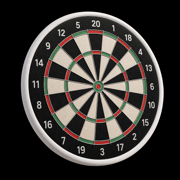
Darts out chart: the preferred finish for every score
A darts out chart lists the best three-dart route to finish every score you can actually close out, from 170 down to 2. Every route ends on a double, because standard 501 is a double-out game. Use it to pick a finish instead of doing arithmetic mid-throw.
What counts as a checkout
A checkout is the visit that takes your remaining score to exactly zero with the last dart in a double. The inner bull counts, since it scores 50 as double 25 — which is why the biggest finishes end there rather than on D20.
Three things kill a visit. Scoring more than you have left is a bust. Leaving exactly 1 is a bust, because 1 has no double. And landing on zero with a single or a treble is a bust. Each time, your score reverts to where it stood at the start of the turn, so the route you choose matters as much as the total you throw. The rules of 501 and 301 cover the rest of the format.
Straight-out and double-in variants turn up in pub and league play, so confirm the format before the first leg. Everything below assumes standard double-out.
Darts out chart: the preferred route for every score from 170 to 2
Read across, then down. T = treble, D = double, 25 = outer bull, Bull = inner bull (50). These are the conventional routes, not the only legal ones — a player who owns D18 will happily leave 36 where the darts checkout table says 32.
| Score | Finish | Score | Finish | Score | Finish |
|---|---|---|---|---|---|
| 170 | T20 T20 Bull | 167 | T20 T19 Bull | 164 | T20 T18 Bull |
| 161 | T20 T17 Bull | 160 | T20 T20 D20 | 158 | T20 T20 D19 |
| 157 | T20 T19 D20 | 156 | T20 T20 D18 | 155 | T20 T19 D19 |
| 154 | T20 T18 D20 | 153 | T20 T19 D18 | 152 | T20 T20 D16 |
| 151 | T20 T17 D20 | 150 | T20 T18 D18 | 149 | T20 T19 D16 |
| 148 | T20 T16 D20 | 147 | T20 T17 D18 | 146 | T20 T18 D16 |
| 145 | T20 T15 D20 | 144 | T20 T20 D12 | 143 | T20 T17 D16 |
| 142 | T20 T14 D20 | 141 | T20 T19 D12 | 140 | T20 T20 D10 |
| 139 | T20 T13 D20 | 138 | T20 T18 D12 | 137 | T20 T19 D10 |
| 136 | T20 T20 D8 | 135 | T20 T17 D12 | 134 | T20 T14 D16 |
| 133 | T20 T19 D8 | 132 | T20 T16 D12 | 131 | T20 T13 D16 |
| 130 | T20 T18 D8 | 129 | T19 T16 D12 | 128 | T18 T14 D16 |
| 127 | T20 T17 D8 | 126 | T19 T19 D6 | 125 | 25 T20 D20 |
| 124 | T20 T16 D8 | 123 | T19 T16 D9 | 122 | T18 T20 D4 |
| 121 | T20 T11 D14 | 120 | T20 20 D20 | 119 | T19 T10 D16 |
| 118 | T20 18 D20 | 117 | T20 17 D20 | 116 | T20 16 D20 |
| 115 | T20 15 D20 | 114 | T20 14 D20 | 113 | T20 13 D20 |
| 112 | T20 12 D20 | 111 | T20 19 D16 | 110 | T20 10 D20 |
| 109 | T20 9 D20 | 108 | T20 16 D16 | 107 | T19 18 D16 |
| 106 | T20 10 D18 | 105 | T20 13 D16 | 104 | T18 18 D16 |
| 103 | T19 10 D18 | 102 | T20 10 D16 | 101 | T17 10 D20 |
| 100 | T20 D20 | 99 | T19 10 D16 | 98 | T20 D19 |
| 97 | T19 D20 | 96 | T20 D18 | 95 | T19 D19 |
| 94 | T18 D20 | 93 | T19 D18 | 92 | T20 D16 |
| 91 | T17 D20 | 90 | T20 D15 | 89 | T19 D16 |
| 88 | T20 D14 | 87 | T17 D18 | 86 | T18 D16 |
| 85 | T15 D20 | 84 | T20 D12 | 83 | T17 D16 |
| 82 | T14 D20 | 81 | T19 D12 | 80 | T20 D10 |
| 79 | T19 D11 | 78 | T18 D12 | 77 | T19 D10 |
| 76 | T20 D8 | 75 | T17 D12 | 74 | T14 D16 |
| 73 | T19 D8 | 72 | T16 D12 | 71 | T13 D16 |
| 70 | T18 D8 | 69 | T19 D6 | 68 | T20 D4 |
| 67 | T17 D8 | 66 | T10 D18 | 65 | T19 D4 |
| 64 | T16 D8 | 63 | T13 D12 | 62 | T10 D16 |
| 61 | T15 D8 | 60 | 20 D20 | 59 | 19 D20 |
| 58 | 18 D20 | 57 | 17 D20 | 56 | 16 D20 |
| 55 | 15 D20 | 54 | 14 D20 | 53 | 13 D20 |
| 52 | 20 D16 | 51 | 19 D16 | 50 | 18 D16 |
| 49 | 17 D16 | 48 | 16 D16 | 47 | 15 D16 |
| 46 | 6 D20 | 45 | 13 D16 | 44 | 12 D16 |
| 43 | 3 D20 | 42 | 10 D16 | 41 | 9 D16 |
| 40 | D20 | 39 | 7 D16 | 38 | D19 |
| 37 | 5 D16 | 36 | D18 | 35 | 3 D16 |
| 34 | D17 | 33 | 1 D16 | 32 | D16 |
| 31 | 15 D8 | 30 | D15 | 29 | 13 D8 |
| 28 | D14 | 27 | 11 D8 | 26 | D13 |
| 25 | 9 D8 | 24 | D12 | 23 | 7 D8 |
| 22 | D11 | 21 | 5 D8 | 20 | D10 |
| 19 | 3 D8 | 18 | D9 | 17 | 9 D4 |
| 16 | D8 | 15 | 7 D4 | 14 | D7 |
| 13 | 5 D4 | 12 | D6 | 11 | 3 D4 |
| 10 | D5 | 9 | 1 D4 | 8 | D4 |
| 7 | 3 D2 | 6 | D3 | 5 | 1 D2 |
| 4 | D2 | 3 | 1 D1 | 2 | D1 |
Why 170 is the highest checkout in darts
170 is T20, T20, bull: 60 + 60 + 50. Nothing bigger ends on a double, so it caps the chart. Players call it the big fish, one of the darts terms you'll hear at the oche.
Above 158, your first two darts top out at 120, so the finishing dart has to be D20 or the bull — and the arithmetic only lands on 160, 161, 164, 167 and 170. That leaves seven scores with no three-dart route at all: 169, 168, 166, 165, 163, 162 and 159. Those are the bogey numbers, and the practical answer is to avoid landing on them, not to memorize a route that doesn't exist. From 158 down to 2, every score has at least one finish.
When you're on a bogey number or above 170, the visit is about the leave, not the finish. Score with the darts you have and try to sit on 32, 40 or another even number for the next visit — and watch the arithmetic, because a score that would leave exactly 1 busts the whole turn.
How the routes are chosen
Two rules generate most of the chart.
Leave an even number. An even remainder can be closed with one dart at a double. An odd remainder can't, so it costs you a setup dart. When your score is odd, spend a dart on an odd single to make it even — 9 from 41 leaves 32, 7 from 39 leaves 32, 3 from 35 leaves 32.
Bend toward 32. Miss D16 into the single 16 and you're left with 16, which is D8. Miss that and you're on D4, then D2, then D1. The 32 finish halves cleanly four times, so a bad dart still leaves a legal shot. D20 is quicker when you hit it, but the 20 bed sits between 1 and 5, and a stray dart there leaves you odd with one dart in hand. That trade-off is why a 501 out chart sends 111 to T20, 19, D16 rather than to T20, 11, D20.
Knowing what each segment on the board is worth makes these routes look obvious rather than arbitrary.
Two-dart and one-dart finishes
Most of the chart collapses into fewer darts when the first one lands where you wanted it. The biggest two-dart finish is 110 — T20, then bull. The biggest that skips the bull is 100, T20 then D20. One dart closes any even number up to 40, plus 50 at the inner bull: 21 scores in total, and those are the ones you want to be sitting on when your last dart is in the air.
Ten checkouts worth memorizing first
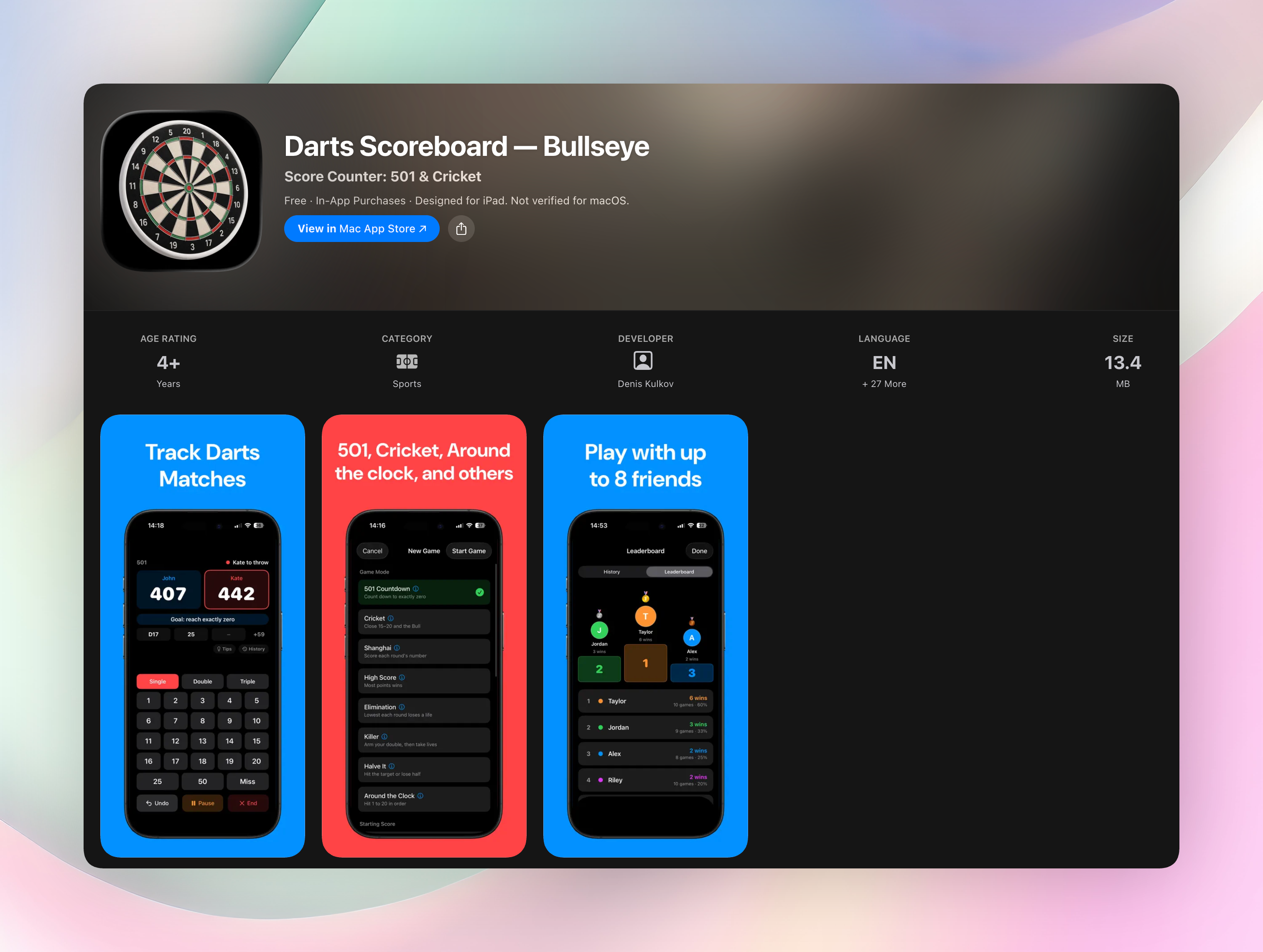
You don't need all 162 rows in your head, and you need fewer still when the remaining score is already in front of you. Darts Scoreboard, a darts scoreboard app for iPhone that tracks your games, keeps the running total visible, which turns the chart into a lookup rather than a memory test.
Learn these ten anyway, because they turn up in almost every leg:
- 40 — D20
- 36 — D18
- 32 — D16
- 24 — D12
- 16 — D8
- 41 — 9, D16
- 60 — 20, D20
- 81 — T19, D12
- 96 — T20, D18
- 100 — T20, D20
The first five are the doubles you'll throw at most often. The rest are the leaves that keep turning up after a 60 or a 100 visit.
FAQ
What is a checkout in darts?
It's the finishing visit — the darts that take your score to exactly zero, with the last one landing in a double or the inner bull. Anything else is a bust, and your score reverts to what it was when the turn began.
What's the highest possible checkout?
170, thrown as treble 20, treble 20, bullseye. It's the largest score that can be closed on a double in three darts, so nothing above it appears on any chart.
Which scores can't be checked out?
159, 162, 163, 165, 166, 168 and 169 — the bogey numbers — plus anything above 170. If your visit would leave you on one of them, throw for a different setup number instead.
Why do so many darts checkout chart routes end on D16?
Because 32 forgives a miss. A dart in the single 16 leaves 16, then 8, then 4, then 2, and every step is still an even number you can shoot at with the darts you have left.
Do I have to finish on a double?
In standard 501 and most league play, yes. Some pub formats play straight-out, and a few play double-in as well as double-out, which changes both ends of the leg. Agree on the format before you throw.
Free Darts tools
- Darts Checkout CalculatorUse this darts checkout calculator to find the best route from your score, see alternative finishes and choose a preferred double.
- Darts Cricket ScorerTrack every player's marks and points in a live darts cricket scoreboard, with open or closed numbers and the winner shown as the game develops.
- Darts Double Out ChartGenerate a complete darts double out chart from 2 to 170. Choose a preferred finishing double and print a route for every finishable score.
- Darts Match CounterA one-handed darts counter for live 301 and 501 matches. Enter each visit to see remaining scores, averages, checkout routes and leg or set state.
- Darts Score Chart CalculatorUse this darts score chart calculator to turn a selected board number and multiplier into the points scored, including valid outer and inner bull options.