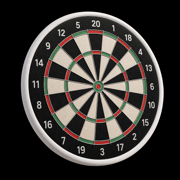
Darts terms explained, from ton to madhouse
Darts terms are shorthand for a score, a match format, or a piece of pub slang. A ton is 100 in three darts, a maximum is 180, the oche is the throwing line, and a bust wipes your visit. This darts glossary covers each and when you'll hear it.
Darts terms for scoring
Your turn is a visit — three darts thrown in a row and scored as a lump. Most darts terminology describes what that lump added up to.
- Ton — 100 in a single visit. Commentary splits the range further: 100–150 is a low ton, 151–180 a high ton.
- Ton-forty — 140, usually two treble 20s and a single 20.
- Ton-eighty, or a maximum — 180. Three treble 20s, the highest score possible with three darts, and the only visit that gets its own drawn-out announcement.
- Checkout — the combination that takes your remaining score to exactly zero. Standard 501 is double out, so it's really a question of leaving yourself a double you can hit.
- Bust — you score more than you need, leave exactly 1, or reach zero with a dart that isn't a double. The visit is void: remaining darts are forfeited and your score reverts to where it stood before the visit.
- Bounce-out — the dart hits a wire and drops out of the board. It scores nothing, and you don't throw it again.
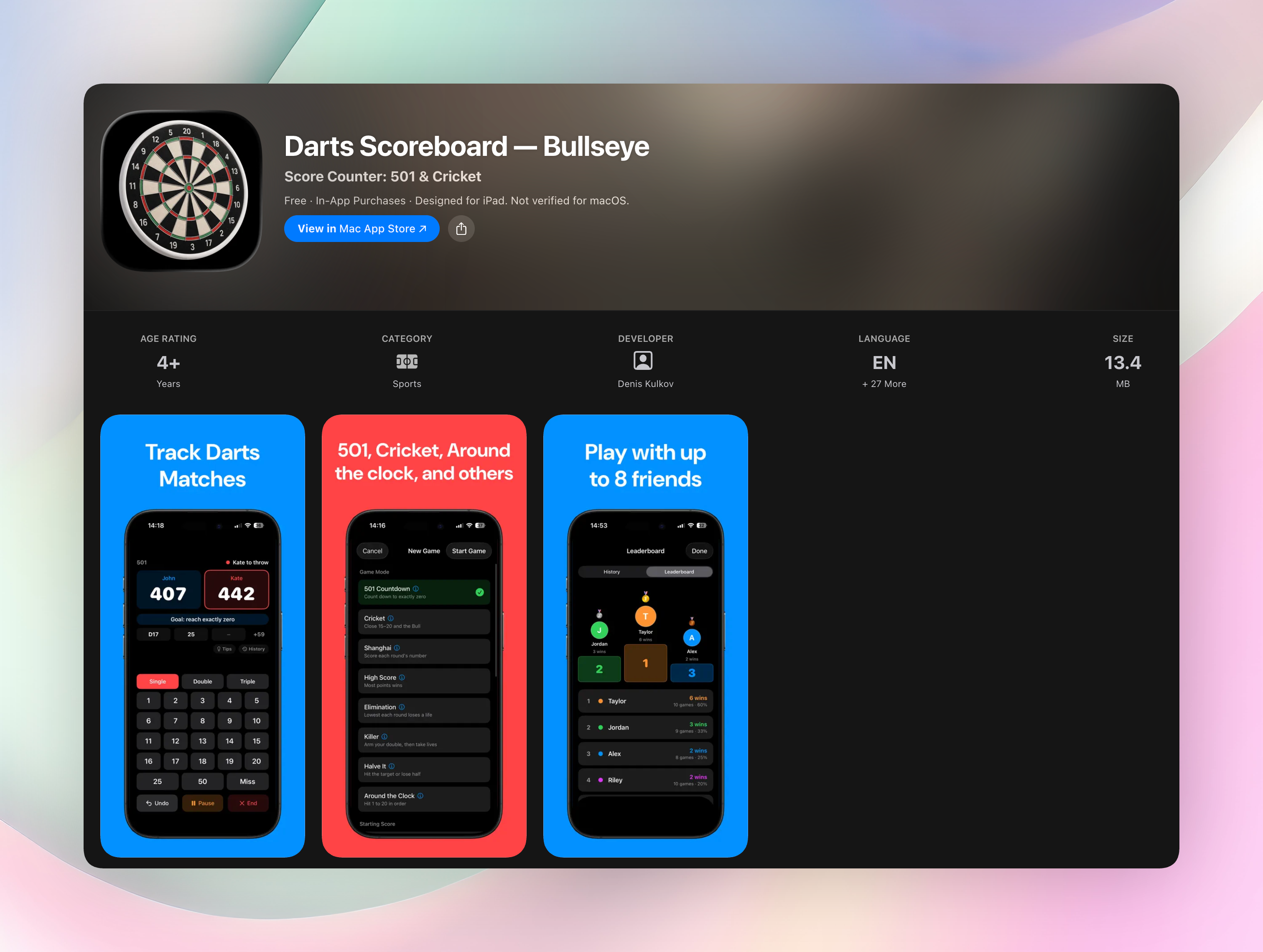
If you'd rather attach the vocabulary to your own throws, Darts Scoreboard is a darts scoreboard app for iPhone that tracks your games, so your tons, maximums and checkouts end up on record instead of in a pub argument.
Some totals picked up nicknames long ago.
| Score | What it's called | One way to get there |
|---|---|---|
| 26 | Bed and breakfast | 20, 5, 1 |
| 45 | Bag o' nuts | 20, 20, 5 |
| 100 | Ton | 60, 20, 20 |
| 140 | Ton-forty | 60, 60, 20 |
| 180 | Ton-eighty, or a maximum | 60, 60, 60 |
Bed and breakfast is the classic bad visit: 20, 5 and 1 sit side by side, so 26 is what you score when the grouping drifts either side of the 20 — named for the old "two and six" charged for a night's room. For the arithmetic behind these totals, start with darts scoring.
Match-format terms: legs, sets, and the oche
The darts lingo around match structure trips up more newcomers than the arithmetic does.
- Leg — one complete game, 501 down to zero. Pub and league matches are usually decided on legs alone: best of five or seven.
- Set — a bundle of legs. At the PDC World Championship a set goes to the first player to win three legs, and the match is decided on sets, so a player can win more legs overall and still lose.
- Oche — the throwing line, pronounced "OCK-ee". For steel-tip, its front edge sits 7 ft 9¼ in (2.37 m) from the face of the board, measured horizontally; soft-tip leagues in North America normally play from 8 ft (2.44 m).
- Chalker — the scorer, traditionally working in chalk on a slate. They subtract each visit and call the remainder aloud.
- Straight in / double in — whether you score from the first dart or have to hit a double before anything counts. Professional 501 is straight in, double out; plenty of league and 301 rule sets require a double to open.
- Mugs away — the loser of the last leg throws first in the next.
- Break of throw — winning a leg your opponent started. The thrower has a one-visit head start, so a break swings a match.
- Three-dart average — points scored divided by darts thrown, times three. Averages in the 90s are professional territory; league players sit well below.
- Checkout percentage — doubles hit divided by doubles attempted. Two players can average the same and be separated by this alone.
Pub darts slang and commentary shorthand
Most darts slang terms come out of pub leagues and survive because they're quicker than the literal description.
- Tops — double 20, worth 40. It's the preferred finish because a dart dropping into the single 20 leaves 20 — double 10, another clean shot.
- Madhouse — double 1, the only finish available when you're down to 2. Miss inside it and you leave 1, an automatic bust, which puts you straight back on 2.
- Robin Hood — a dart that lands in the back of a dart already in the board. It scores nothing and isn't re-thrown.
- Wet feet, or paddling — throwing with a foot over the oche line. The penalty is a league matter, usually a warning; you never get the darts back.
- Shanghai — the single, double and treble of one number in a single visit. It's also the nickname for the 120 finish (treble 20, single 20, double 20).
- Big Fish — the 170 checkout: treble 20, treble 20, bullseye. The bull counts as a double, which is what makes it a finish; none higher exists. Seven numbers just below it — 169, 168, 166, 165, 163, 162 and 159 — can't be checked out at all; those are the bogey numbers.
- Nine-darter — 501 finished in nine darts, the fewest the maths allows.
- Diddle for the middle — each player throws one dart at the bull to decide who starts. Also called bulling up.
Cricket carries its own vocabulary — marks, points, closing a number — covered in the cricket darts rules.
FAQ
What is a 180 in darts?
A 180 is the highest score possible with three darts: three treble 20s in one visit. It's called a maximum, or a ton-eighty — the one total that gets announced rather than written down.
What is a ton in darts?
A ton is 100 scored in one three-dart visit. Bigger totals take a suffix — ton-forty is 140, ton-eighty is 180 — and commentators divide the range into low tons (100–150) and high tons (151–180). Below 100 there's no nickname, just the number.
What does madhouse mean in darts?
Madhouse is double 1, the finish you're left with when your score drops to 2. Hit the single 1 and you leave 1, which busts automatically, so the visit ends and you start the next one back on 2.
What is a Robin Hood in darts?
A Robin Hood is a dart that sticks into the back of a dart already in the board rather than the board itself. It scores nothing, can't be thrown again, and usually ruins the flight it hit.
Why is the throwing line called the oche?
The origin isn't settled — the most repeated explanation ties it to a dialect word for a notch cut into a floor, and the pub brewery-crate story is folklore. The measurement isn't in dispute: 7 ft 9¼ in (2.37 m) from the face of the board for steel-tip darts.
Free Darts tools
- Darts Checkout CalculatorUse this darts checkout calculator to find the best route from your score, see alternative finishes and choose a preferred double.
- Darts Cricket ScorerTrack every player's marks and points in a live darts cricket scoreboard, with open or closed numbers and the winner shown as the game develops.
- Darts Double Out ChartGenerate a complete darts double out chart from 2 to 170. Choose a preferred finishing double and print a route for every finishable score.
- Darts Match CounterA one-handed darts counter for live 301 and 501 matches. Enter each visit to see remaining scores, averages, checkout routes and leg or set state.
- Darts Score Chart CalculatorUse this darts score chart calculator to turn a selected board number and multiplier into the points scored, including valid outer and inner bull options.