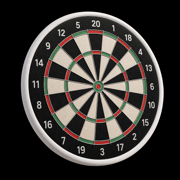
Darts games beyond 501: 8 board classics with full rules
Beyond 501, the darts games most often played on a standard board are Killer, Around the Clock, Shanghai, Halve It, Baseball, Golf, High Score and Tic-Tac-Toe. All eight need nothing but the board you already have. Full rules for each below, ranked by how well they hold a room.
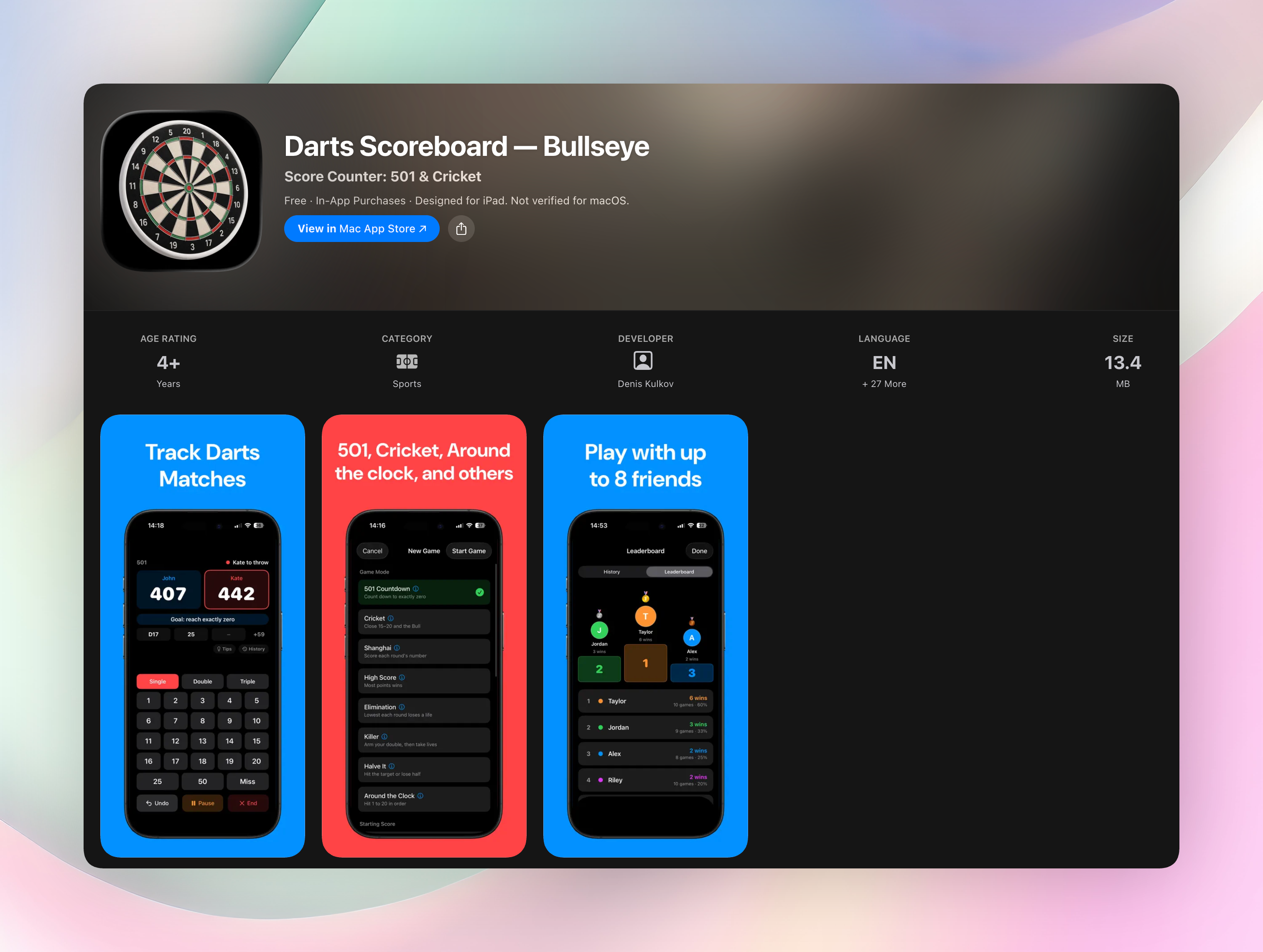
Most of them die out for the same reason: the rules are simple, the bookkeeping isn't. Halve It and Baseball need a running total per player per round, and by the second game someone's chalk column is wrong and the night quietly reverts to 501. Darts Scoreboard is a darts scoreboard app for iPhone that tracks your games, so the running totals for multi-player formats live somewhere other than a smudged chalkboard.
Which darts games to play, by group size
Player count matters more than skill here.
| Game | Players | Length | Best for |
|---|---|---|---|
| Killer | 4–10 | 15–25 min | Big groups, mixed ability |
| Around the Clock | 1–4 | 5–10 min | Accuracy, first-timers |
| Shanghai | 2–6 | 5–10 min | Short games, comebacks |
| Halve It | 2–4 | 10–15 min | Practice under pressure |
| Baseball | 2–4 | 10–15 min | Beginners, learning the board |
| Golf | 2–4 | 15–20 min | Hitting one number on demand |
| High Score | 2–8 | Under 5 min | Settling something fast |
| Tic-Tac-Toe | 2 | About 10 min | Head-to-head tactics |
1. Killer, the format that survives a crowd
4–10 players · 15–25 minutes
Everyone throws one dart with their non-dominant hand to claim a number. If it's already taken, throw again. Chalk the numbers up with three lives each, five for a longer game.
You become a killer by hitting the double of your own number, and until then you can't touch anyone. Once you're a killer, every opponent's double you hit costs them a life — and hitting your own double by mistake costs you one, so you can kill yourself by accident. Last player with a life wins.
This is the pub darts game that scales: short waits with eight people, and every dart aimed at somebody. Beginners stay competitive too: a wide double like 16 is as findable for them as for a league player.
2. Around the Clock, the accuracy drill
1–4 players · 5–10 minutes
Hit 1, then 2, then 3, all the way to 20, three darts a visit. Only your current target counts, so a 19 while you're chasing 7 does nothing. First to close 20 wins.
Around the clock darts is the drill every new player gets handed, and it earns that: you aim at all twenty beds instead of camping in the 20/19 corner. Agree the variant first. Doubles advancing you two numbers and trebles three makes it faster and teaches the rings. Some groups add the bull as a 21st target, or require a double 20 to finish.
For a first-timer, use the plain any-segment version and read how to play darts for stance and grip first.
3. Shanghai, seven rounds and a sudden ending
2–6 players · 5–10 minutes
Round one, three darts at the 1. Round two, at the 2. Only the round's number scores and the rings multiply, so a treble 5 in round five is 15. Play 1 through 7 for a quick game or 1 through 20 for a long one. Highest total wins.
Then the rule the game is named for: hit a single, a double and a treble of that round's number in one visit and you win outright, whatever the scores are. Order within the visit doesn't matter in the standard game, though some houses insist on single, double, treble in that sequence — settle it beforehand, because it changes how you throw the last dart.
Shanghai is the best short format here because it's never decided early: someone 90 behind in round six can still take it with one visit.
4. Halve It, one bad visit and half your score is gone
2–4 players · 10–15 minutes
Write one target per round down the board. A short set is 20, 19, 18, 17, 16, doubles, trebles, bull. The long version runs 13 rounds: 12 through 20, plus a doubles round, a trebles round, a round where you must score exactly 41 with three darts, and the bull. Throw three darts at the round's target and add what you hit, rings at full value. Miss with all three and your running total is halved.
Highest score at the end wins. The halving is meant to hurt. A total of 186 becomes 93 because you couldn't find a double in three darts, and the leader can be last a round later. That's what makes it the sharpest practice game on the list: one round of pressure per target, no comfortable warm-up.
5. Baseball, nine innings on 1 through 9
2–4 players · 10–15 minutes
The darts baseball game maps nine innings onto the numbers 1 through 9. First inning at the 1, second at the 2, and so on. A single is one run, a double two, a treble three, and runs are never multiplied by the inning number, so a perfect inning is nine runs and a perfect game is 81. Anything off the inning's number scores nothing. Most runs after nine innings wins, and tied games go to extra innings.
It's the friendliest entry point here. The low numbers sit in big, forgiving beds, so a beginner scoring 2 a round stays with a good player scoring 5. It teaches the layout fast too — nine rounds hunting numbers you'd otherwise never aim at. The dart board scoring values are worth a glance first.
6. Golf, nine holes and the lowest score wins
2–4 players · 15–20 minutes
Hole one is the 1, hole nine is the 9, and the lowest total wins. The most common stroke values are a double for 1, a treble for 2, a single for 3, and a complete miss for 5. Only your last dart counts, so you can stop after one throw. Hit the double with your first dart and throwing again is madness, because a follow-up single turns your 1 into a 3.
Stroke values vary by house. Some make the treble the hole-in-one, others score the inner single 3 and the outer single 4. Agree one before the first hole. The long version plays eighteen holes on 1 through 18.
7. High Score, the simplest game on the board
2–8 players · under 5 minutes
Three darts a visit at whatever you like, for an agreed number of rounds. Five is standard, ten if you want the better thrower to actually win. Highest total takes it. Face value applies, trebles triple, the bull is 50, so one visit tops out at 180.
There's no strategy past target selection, which is the point. It settles who's buying in five minutes, and it's the fallback when the group is too big or the evening too far gone. It's also the cleanest read on raw scoring power, and darts scoring covers why treble 19 is the sensible second target.
8. Tic-Tac-Toe, the best head-to-head game
2 players · about 10 minutes
Draw a 3×3 grid on the chalkboard and put a target in each square. A typical set is 20, 19, 18, 17, 16, 15, the bull, any double and any treble, though any nine targets work. Alternate visits, and hitting a square's target claims it. Three in a row in any direction wins; a full grid with no line is a draw.
It's the most tactical of the dart board games listed here, because half your darts go into blocking rather than claiming. The bull square usually decides the game, so only put it in the center if you both want a long one. It doesn't scale; with a third person waiting it drags.
House rules to settle before the first dart
Different darts games carry different local rules, and most arguments start from assuming yours is standard. Three worth agreeing first:
- Halving direction. In Halve It, some groups round the halved total down and others round up. On an odd score that's a point, and a point decides games.
- Losing killer status. Some Killer variants strip your killer status when you drop a life, so you have to hit your double again. It stretches the endgame considerably.
- Bull value. Scoring games treat the outer bull as 25 and the inner as 50, but plenty of pub darts games count the whole bull as one target.
FAQ
What darts game is best for a big group?
Killer. It handles eight to ten players better than anything else — the turn cycle stays short and every number on the board is live. High Score works if you just want something finished quickly. Shanghai holds up to about six before the wait between visits gets long.
What is the easiest darts game for beginners?
Baseball. The nine innings use 1 through 9, all large single beds, and the arithmetic never goes past adding three runs. Around the Clock is the other common first game, though a beginner can stall on one number for several visits.
How do you play around the clock darts?
Hit every number from 1 to 20 in order, three darts a visit, and the first to close 20 wins. Only your current target counts. Many groups let a double jump you two numbers and a treble three, which shortens the game and pushes you onto the rings.
Which darts game is best for practice?
Halve It for accuracy under pressure, High Score for raw scoring, Golf for hitting a specific number on demand. Halve It is closest to a real match: each target gets one round with a penalty attached, not ten minutes of repetition.
Free Darts tools
- Darts Checkout CalculatorUse this darts checkout calculator to find the best route from your score, see alternative finishes and choose a preferred double.
- Darts Cricket ScorerTrack every player's marks and points in a live darts cricket scoreboard, with open or closed numbers and the winner shown as the game develops.
- Darts Double Out ChartGenerate a complete darts double out chart from 2 to 170. Choose a preferred finishing double and print a route for every finishable score.
- Darts Match CounterA one-handed darts counter for live 301 and 501 matches. Enter each visit to see remaining scores, averages, checkout routes and leg or set state.
- Darts Score Chart CalculatorUse this darts score chart calculator to turn a selected board number and multiplier into the points scored, including valid outer and inner bull options.